
Explore Questions 46–50 in Buddhism for Beginners,
covering Right Livelihood, ethical living, choosing the right meditation method, and the fundamental principles of meditation practice.
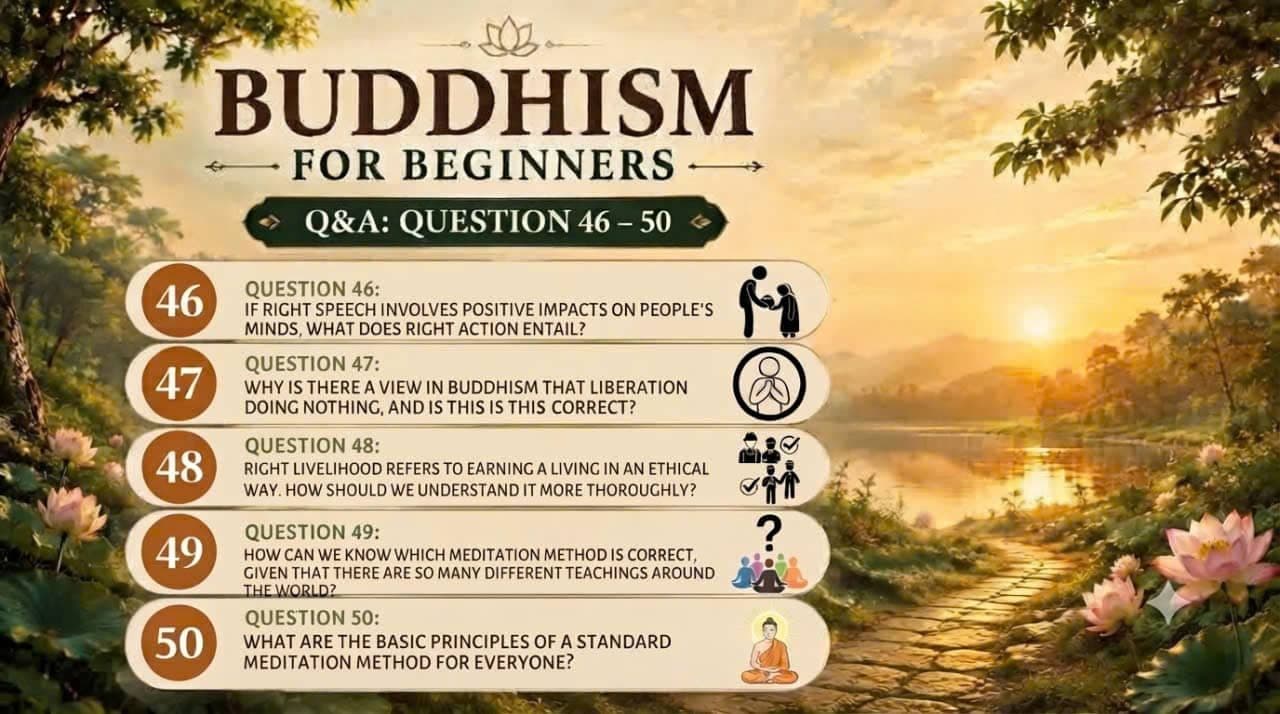
BUDDHISM FOR BEGINNERS – Q&A: QUESTION 46 – 50
Question 46: IF RIGHT SPEECH INVOLVES POSITIVE IMPACTS ON PEOPLE'S MINDS, WHAT DOES RIGHT ACTION ENTAIL?
Answer: Right Action involves positively impacting the lives of others.
Karma is created when we affect other people's lives. If we improve someone’s life and bring them happiness, it is considered good karma; if we make their lives worse and cause them suffering, it is considered bad karma.
Right Speech transforms the mind, while Right Action transforms life itself, which essentially means helping others. We can help others at various levels, from basic to advanced, such as:
- Providing food, clothing, housing, clean water.
- Supplying medicine, elder care, transportation.
- Offering education, career, employment, and safety.
- Promoting morality, culture, and positive lifestyles.
- Creating opportunities for volunteer work.
- Encouraging spiritual practice towards enlightenment and offering the chance for spiritual practices.
- Helping propagate the true Dharma.
Looking at this ladder of Good Karma, we can see that it is not enough to improve others' lives; we must also encourage others to do good deeds and create their own positive karma.
Of course, we cannot fully help everyone from basic to advanced levels. We can only choose ways to help that align with our abilities, current circumstances, the person's needs, and their level of understanding.
Regardless of how we help, our ultimate goal should be to help people in their spiritual practice toward enlightenment. Every other level of help is merely the means to reach that goal.
Question 47: WHY IS THERE A VIEW IN BUDDHISM THAT LIBERATION MEANS DOING NOTHING, AND IS THIS CORRECT?
Answer: Doing nothing is not part of the Noble Eightfold Path taught by the Buddha. The Noble Eightfold Path includes Right Actions, not "no action".
The view that doing nothing leads to liberation stems from misunderstandings within Buddhism itself.
The first misunderstanding is that observing Buddhist precepts means merely refraining from doing wrong while forgetting the other essential aspect, which is actively doing good. Practitioners might mistakenly believe that not committing wrongdoings is sufficient for spiritual liberation. In reality, avoiding wrongdoing must be coupled with actively doing good, as taught by the Buddha in the Dhammapada.
Another misunderstanding arises from the Mahayana Prajnaparamita (Perfection of Wisdom) teachings. These texts, like the Diamond Sutra, instruct Bodhisattvas to perform countless virtuous deeds without keeping in mind those good deeds. However, many people misinterpret this as meaning they should do nothing at all.
Due to these fundamental misunderstandings, many Buddhist practitioners become passive and reluctant to do good deeds, resulting in a lack of blessings and weakening Buddhism's ability to thrive and spread its teachings as a whole.
Question 48: RIGHT LIVELIHOOD REFERS TO EARNING A LIVING IN AN ETHICAL WAY. HOW SHOULD WE UNDERSTAND IT MORE THOROUGHLY?
Answer: Everyone needs to have a profession or occupation to support themselves and their family, pay taxes, and contribute to society. Young people depend on their families for support, while the elderly may rely on pensions or assistance from their children. People of working age generally must find an occupation to make a living, except for those who have accumulated great merit in the past and come from an exceptionally wealthy family, so they do not need to work.
The immediate purpose of a profession is to provide for oneself, while its broader purpose is to contribute to society. These two purposes are fair and balanced: contribution leads to benefits.
Those who deeply understand the Law of Karma always strive to contribute more than they receive to accumulate merit. In contrast, those who do not understand the Law of Karma tend to focus more on maximizing personal gain.
Some jobs offer high income but contribute little to society, while others contribute significantly but come with low pay.
There are professions in which the more one works, the more merit one gains; these are considered Right Livelihood. Conversely, there are jobs in which the more one works, the more sin one accumulates; these are considered Wrong Livelihood.
In both cases, we earn wages to make a living, but with the Right Livelihood, we provide practical and reasonable benefits that help others grow morality. With Wrong Livelihood, we may spread superstition, cause unrest, or harm. By evaluating how the jobs impact the lives and minds of others, we can understand what constitutes Right or Wrong Livelihood.
Question 49: HOW CAN WE KNOW WHICH MEDITATION METHOD IS CORRECT, GIVEN THAT THERE ARE SO MANY DIFFERENT TEACHINGS AROUND THE WORLD?
Answer: Meditation methods vary because of the different experiences of those who teach meditation to calm the mind.
In reality, the psychological makeup, brain structure, and past karma of each person differ, so each individual's ability to concentrate and enter a meditative state will also vary. Meditation teachers (*) often confidently share their methods based on personal experience.
Some people find it easy to calm their minds and can reduce distractions with minimal effort. So they may teach a simplistic meditation method that is not meticulous and beneficial for everyone.
Others may be taught unique methods by their teachers and, coupled with their own past karma, achieve success in meditation. They may then strongly assert that their method is the only correct one.
When exploring meditation extensively, we may be surprised by the numerous different approaches, leaving us uncertain about which one to choose. With significant past merit, we may succeed in meditation with any method we choose, then we will come to have absolute faith in that method and go on to teach it to others. In contrast, if we lack past merit, we may struggle in our meditative practice without achieving the desired results, making us feel confused and eventually we have to seek other meditation methods.
The key is to look beyond specific methods and seek the fundamental principles of meditation that can be applied to all levels of spiritual aptitude, psychological types, and brain structures, much like a standard education curriculum designed for all children.
Those who wish to learn meditation should pray to the Buddha to find a truly wise master who can guide them to the correct method so that their practice is fruitful and they can effectively teach others.
(*) teacher in Buddhism refers to someone who imparts knowledge of the Dharma, teaches meditation techniques, and provides guidance in practice. All masters are teachers, but not all teachers are considered masters. A master has achieved a higher level of spiritual realization and is revered for their deep understanding and ability to lead others to enlightenment.
Question 50: WHAT ARE THE BASIC PRINCIPLES OF A STANDARD MEDITATION METHOD FOR EVERYONE?
Answer: The fundamental principles of a meditation method that can be applied to all individuals include the following:
-
Encouraging the accumulation of merit: To enter deep ecstasy in meditation, one must have great merit. Because achieving a tranquil mind in meditation is akin to reaching the state of the heavenly realm, which requires substantial merit.
-
Reverence for the Buddha and Arahants: This is the basic merit for meditation. According to the Law of Karma, honoring teachers allows one to become a teacher in the future; similarly, showing reverence to Enlightened Ones who have achieved the ultimate level of ecstasy in meditation enables one to attain higher meditative states.
Regularly repentance for past sins: Practitioners should regularly pay homage to the Buddha to repent for past sins in daily life. -
Cultivation of inner morality: Practitioners must be thorough and determined in perfecting inner morality, identifying and correcting every fault, as a tranquil mind follows a virtuous heart.
-
Maintaining good health: Meditation practice requires good health. Practitioners need to engage in physical exercises like Qigong, follow a balanced diet, work and rest appropriately, and get enough sleep.
When practicing meditation, the following basic methods should be observed: -
Proper sitting posture: Sit in the full lotus position in a quiet, cool, secluded place. Keep the body relaxed and still. Position the arms with elbows slightly away from the sides rather than pressed against the body. Keep the back straight but not tense. Initially, keep the eyes open, looking down at a spot in front of us with the head slightly bowed; once the mind is more mindful, it is ok to close the eyes. Keep the mouth gently closed, with the tongue touching the upper gums.
Cultivation of fundamental morality: Develop intentions to revere the Buddha absolutely, love all beings boundlessly, and maintain utmost humility.
-
Praying for guidance: Pray for the Buddha’s guidance to achieve a deep meditative state towards ultimate selflessness.
-
Contemplating the body and mind: Reflect that this body and mind are the result of deep-seated past sins.
-
Acknowledging distraction: Begin to recognize when the mind is led by wandering thoughts. Do not try to forcefully eliminate these thoughts or concern ourselves with their content; simply be aware of their presence. When we realize that the mind is distracted, we have achieved an initial stage of mindfulness.
-
Maintaining mindfulness: Focus our sensations on the chest and abdomen, as these areas help sustain mindfulness and prevent strong wandering thoughts from leading the mind astray. This is the second stage of mindfulness.
-
Contemplating impermanence: Reflect on the body's impermanence – it will age, fall ill, and eventually die. This is the third step of awareness.
-
Regulating breathing: Keep the breath slow, little, and gentle. With mindfulness, the breath becomes clear, but inner impulses may cause it to be rapid, deep and strong. So, carefully maintain slow, shallow, and gentle breathing to prevent these impulses from taking over. This is the fourth stage of mindfulness.
-
Mindfulness of the entire body: Be mindful of the whole body, sensing down to the bottom of the abdomen, including the Dan Tian and Hui Yin acupoints. Awareness of the bottom of the abdomen can help heal some latent brain injuries and make the mind more tranquil. This is the fifth stage of mindfulness.
-
Recognizing deep-seated ignorance: As mindfulness becomes sustained and the mind is less frequently led astray by wandering thoughts, constantly remind ourselves that ignorance and sins still reside deep within the mind. This is the sixth step of awareness.
Practitioners should repeat these six mindfulness stages to maintain awareness and prevent the mind from being led astray by wandering thoughts.
Additionally, contemplating the body and mind as an accumulation of karmic wrongdoings from countless past lives also helps maintain awareness, because it means that we are recognizing our state, acknowledging our karma, and understanding our nature, which aids in repentance and lightens our karmic burden.
As mindfulness strengthens, many more states of awareness will emerge, which we will discuss later.
Written by:
Janna
Related Articles:
Buddhism for Beginners – Q&A: Questions 41–45 on Karma, Morality
Buddhism for Beginners – Q&A: Questions 36–40
Buddhism for Beginners – Q&A: Questions 31–35 | Spirits, Merit.
Buddhism for Beginners Q&A: Questions 26–30 – Suffering, Liberation
Buddhism Q&A 21–25: Nirvana and the Four Noble Truths
Buddhism Questions 16–20: Heaven, Karma, Nirvana & Enlightenment
Partnership: Loyalty, Gratitude and Choosing the Right
Instruction on Meditation: Essential Methods and Practice Guide