
Explore Buddhist teachings on the cessation of suffering,
the four stages of enlightenment, the Noble Eightfold Path, the Law of Karma, and Right Comprehension.
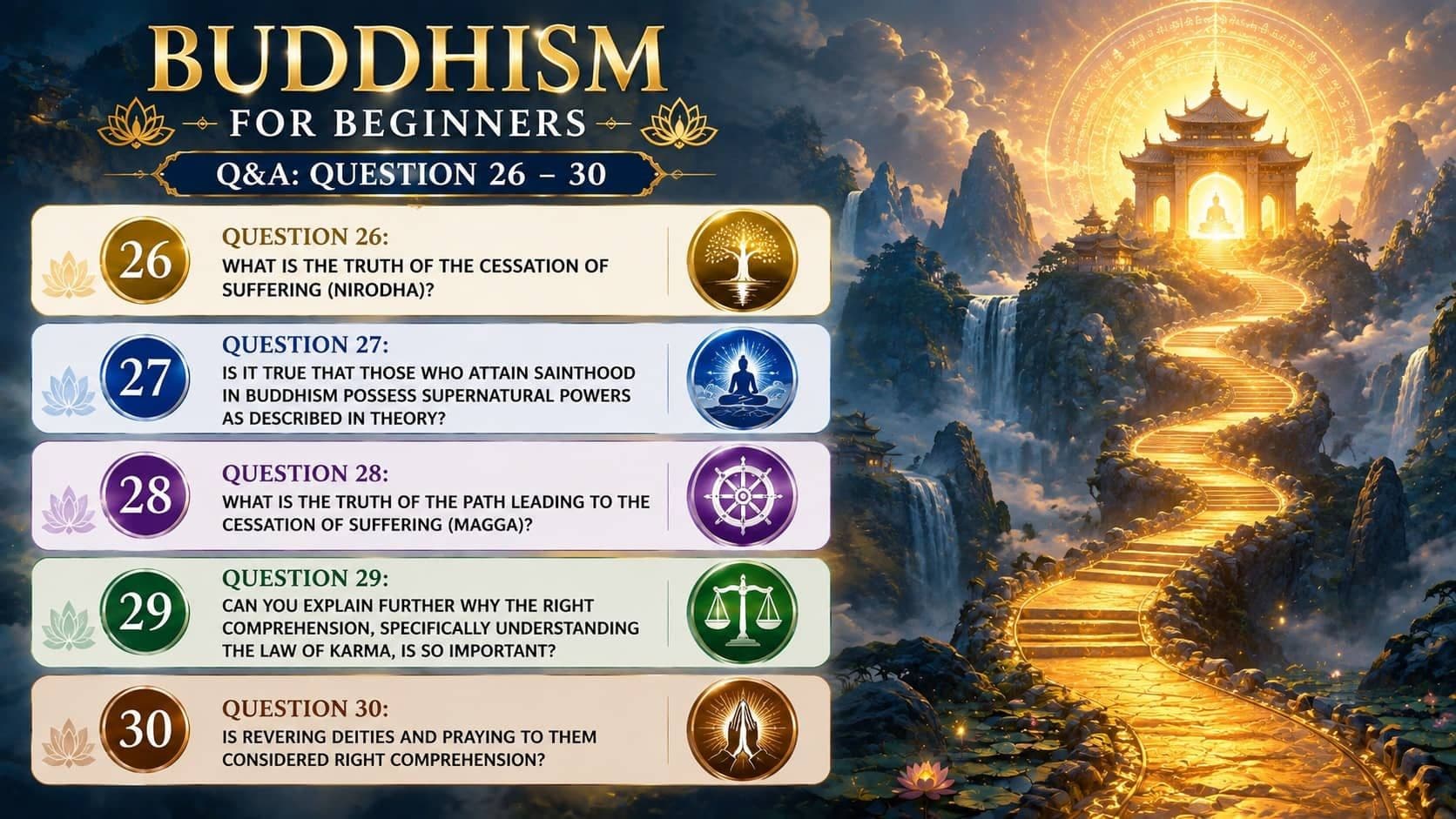
BUDDHISM FOR BEGINNERS – Q&A: QUESTION 26 – 30
Question 26: WHAT IS THE TRUTH OF THE CESSATION OF SUFFERING (NIRODHA)?
Answer: The Truth of the Cessation of Suffering (Nirodha) refers to the state of being free from suffering, known as enlightenment and liberation, achieved through successful spiritual practice in line with the Buddha’s teachings.
While many religions see reaching heaven after death as the ultimate goal for a faithful follower, Buddhism defines true spiritual success as achieving extraordinary inner enlightenment. After attaining enlightenment, one can freely choose where to be or choose not to exist in any place at all. There are four stages of enlightenment:
-
Arahant (Arhat): The fourth and highest stage of enlightenment. An Arahant possesses the Threefold Knowledge and Six Supernormal Powers, achieving complete liberation from the universe, with boundless wisdom and enlightenment.
-
Anāgāmi (Non-returner): The third stage of enlightenment. An Anāgāmi is no longer reborn into the human realm unless they choose to be. They possess great spiritual powers and wisdom, and often reside in the highest heaven of the Form Realm (Suddhāvāsa), continuing their practice until they attain Arahantship and enter Nirvana.
-
Sakadāgāmi (Once-returner): The second stage of enlightenment. A Sakadāgāmi may be reborn in the human realm once more to complete their virtues and aspirations. They possess a very pure mind and some basic supernormal powers. After death, they are often reborn in the Tusita Heaven to learn from Maitreya Buddha, the future Buddha of Earth in the next hundreds of thousands of years.
-
Sotāpanna (Stream-enterer): The first stage of enlightenment. A Sotāpanna may be reborn multiple times into the human realm to fulfil their virtuous aspirations for themselves and other beings. They have an unwavering commitment to morality and absolute reverence for the Buddha. However, they do not yet have enough supernatural wisdom to discern reality from illusion, so they still make mistakes and have karma to resolve. A Sotāpanna may be reborn in the Heavens of Desire Realm or multiple times in the human realm. They often engage in good deeds, resulting in good connections with beings and easily earning blessings.
The Threefold Knowledge of an Arahant includes:
-
Knowledge of Past Lives (Pubbenivāsānussati-ñāṇa): The ability to see one’s countless past lives in great detail and understand one's connections with innumerable other beings.
-
Knowledge of the Death and Rebirth of Beings (Dibbacakkhu): The ability to see the rebirth of beings across countless lifetimes, observing their karmic actions and consequences according to the Law of Karma with clarity and detail.
-
Knowledge of the End of Mental Defilements (Āsavakkhaya-ñāṇa): The ability to see the ultimate truth of the universe, understanding the Four Noble Truths and the workings of everything and every realm, with the capacity to know anything they wish to know, yet primarily grasping the profound wisdom of the Dharma.
The Six Supernormal Powers of an Arahant consists of the Threefold Knowledge and add the following:
-
Supernatural Power (Iddhi-vidhā): The ability to perform supernatural feats, such as flying, creating multiple bodies, manipulating the elements, and transforming environments.
-
Telepathy (Cetopariya-ñāṇa): The ability to know the thoughts of other beings, even from a great distance.
-
Clairaudience (Dibbasota): The ability to hear sounds of beings from all realms.
The realms of Heavens can also be considered as part of the Cessation of Suffering because they alleviate many sufferings experienced in the human and animal realms. However, true Cessation of Suffering in Buddhism is only achieved through attaining inner enlightenment.
Question 27: IS IT TRUE THAT THOSE WHO ATTAIN SAINTHOOD IN BUDDHISM POSSESS SUPERNATURAL POWERS AS DESCRIBED IN THEORY?
Answer: Buddhist scriptures document many instances of the Buddha and Arahants demonstrating extraordinary supernatural powers. For instance, there is a story of the venerable Gavampati using his supernatural power to stop a sudden flash flood from an overflowing river, causing the water to pile up high in the sky. This allowed the monks sleeping on the riverbank to escape to higher ground before Gavampati released the floodwaters to flow normally again.
In China, during the Tang Dynasty (618-907 CE), there is a story of Zen master Deng Yinfeng. While passing by a battlefield where two armies were fighting fiercely, he flew up into the sky and gestured for them to stop, causing both armies to retreat and cease fighting.
In Vietnam, during the Ly Dynasty (1009-1225 CE), two Zen masters, Minh Tam and Bao Tanh, after delivering a sermon, ascended into the air, set themselves aflame, and entered Nirvana.
There are numerous stories of the supernatural powers of Saints in Buddhism, recorded extensively in Buddhist scriptures and historical texts worldwide.
Question 28: WHAT IS THE TRUTH OF THE PATH LEADING TO THE CESSATION OF SUFFERING (MAGGA)?
Answer: The Truth of the Path Leading to the Cessation of Suffering (Magga) refers to the way leading to the end of suffering and the attainment of transcendent Nirvana. It can be described as a method, an approach, or a roadmap. The Truth of the Path is a comprehensive system of practice in Buddhism, vast, perfect, thorough and detailed, encompassing a long journey from basic to advanced stages. It includes the following eight components, known as the Noble Eightfold Path:
-
Right Comprehension: Understanding Buddhist doctrines for practice correctly is crucial because misunderstanding or holding wrong views leads to erroneous practices, making practitioners stray from the Right path, resulting in wrongdoing and more suffering. However, people with misguided views on cultivation always insist that they are right, making it very difficult for them to change. There are two critical aspects of Right Comprehension in Buddhism: understanding the Law of Karma and the goal of enlightenment which is being free from the self (ego).
-
Right Consideration: Based on Right Comprehension, one must think and reflect in alignment with the Dharma to transform the mind to become pure and virtuous, eliminating wrong thoughts and perfecting deep morality. The process of filtering out wrong thoughts is challenging and solitary, as no one else can see our mind to assist us. Thus, we must evaluate our own thoughts in solitude to make adjustments. Correct thinking also creates merit.
-
Right Speech: With Right Comprehension and the ethics of Right Consideration, one should convey only positive and meaningful messages that help others progress in their practice. Our language and attitude must be cultured, ethical, and beneficial, forming virtuous karma and increasing blessings through speech.
-
Right Action: These are actions that interact with and influence other sentient beings, the community, and the minds and lives of others. Practitioners must actively create positive impacts, helping beings to be happy, well-provided, knowledgeable, moral, and inspired towards enlightenment, thereby accumulating increasing merit that supports spiritual practice and meditation.
-
Right Livelihood: This refers to earning a living through righteous means. Everyone needs a job to earn income for food, clothing, housing, and necessities. Monastics live by alms and offerings given by the faithful, a form of Right Livelihood. Laypeople work in various businesses or professions to make a living. The merit from Right Actions enables one to choose a righteous livelihood, avoiding harmful or unethical jobs. A Right Livelihood helps one earn more and more merit over time.
-
Right Endeavour: This is the effort in meditation practice. Meditation is the final path to spiritual enlightenment, requiring control of the mind and cessation of wandering thoughts to reach the ultimate truth. However, concentrating the mind in meditation is extremely difficult, and most people fail. Right Endeavour refers to the stage where one practices a meditation method without attaining any immediate results, yet persists without giving up. The term 'Right' also implies the correctness of meditation methods, as many unknowingly practice incorrect meditation methods. Practitioners should pray to find a true Zen master who can guide the correct meditation approach, to avoid wasting effort.
-
Right Mindfulness: At this stage, meditation practice begins to yield results. Wandering thoughts no longer dominate, and the practitioners frequently experience mindfulness. This stage is not yet extraordinary, as the mind remains flawed and still prone to faults, but mindfulness serves as a guiding light. The term 'Right' in this stage indicates that practitioners must understand that, even with mindfulness, they remain flawed and must continue to practice diligently without becoming complacent or relaxed, which could lead to regression. Mindfulness can also give practitioners additional motivation to continue their spiritual practice.
-
Right Ecstasy: At this stage, a conscious effort is no longer needed to focus the mind, as the mind naturally abides in tranquillity. There are four levels of Right Ecstasy: First Jhana, Second Jhana, Third Jhana, and Fourth Jhana. These indicate different depths of tranquillity. Though the mind is tranquil, depth varies, and not all tranquil states of mind are the same. In daily life, practitioners maintain mindfulness (Right Mindfulness) and enter deeper meditative states whenever they want. In the Third Jhana, one delves into the subconscious, understanding the autonomic nervous system's secret workings. In the Fourth Jhana, one perceives the universe's profound nature, far beyond scientific understanding.
The Noble Eightfold Path is an extensive system of practice requiring many lifetimes for a being to be able to attain liberation and enlightenment in Nirvana.
Question 29: CAN YOU EXPLAIN FURTHER WHY THE RIGHT COMPREHENSION, SPECIFICALLY UNDERSTANDING THE LAW OF KARMA, IS SO IMPORTANT?
Answer: Without a thorough understanding of the Law of Karma, we may hold onto wrong views, perceive things incorrectly, misinterpret everything, and act mistakenly, which diminishes our merit, causes us to accumulate negative karma, and ultimately closes off the path to spiritual enlightenment.
For example, if we see a practitioner living in solitude and diligently meditating, achieving spiritual results, we might conclude that solitude led to their success in practice. This view does not align with the Law of Karma and is therefore inaccurate. We must understand that the practitioner may have revered an enlightened Saint in the past or, despite living in solitude, consistently pays homage to the Buddha and maintains a vast compassion for all beings, combined with proper meditation practice to achieve such results.
Similarly, when we see someone born into a wealthy family and simply attribute their situation to luck without further reflection, we are missing the Law of Karma. To be born into a wealthy family, this person must have accumulated significant merit in past lives, allowing them to enjoy prosperity and comfort from birth in this life.
Conversely, when we see a poor person and assume they are lazy or unwilling to work, we are also ignoring the Law of Karma, pushing us to fall into the wrong views. Many hardworking people remain impoverished due to a lack of opportunities, assistance, or frequent misfortune. Poverty can result from various karmic causes, not just a single fixed cause. Poverty may result from stinginess, wastefulness, looking down on the poor, improper use of money, or giving to unworthy individuals…
Question 30: IS REVERING DEITIES AND PRAYING TO THEM CONSIDERED RIGHT COMPREHENSION?
Answer: Actually, most deities introduced by various religions are mythical characters without a historical basis. The characteristics of these deities depend on the understanding of those who introduce them. If the introducer has a profound understanding, they will describe the deity as sublime; if their understanding is shallow, the deity will be described in simpler terms.
The key factor determining whether praying to a deity aligns with the Right Comprehension is the fairness of that deity. If the deity rewards and punishes justly according to the Law of Karma, then praying to them is considered Right Comprehension. In contrast, if the deity does not adhere to fairness and instead favors those who lavish them with flattery and offerings, then praying to them becomes a misguided belief.
Written by:
Janna
Related Articles:
Meditation Q&A: Question 7 – Meditation Techniques from Basic to Advanced
Meditation Q&A – Question 06: Is Stopping Thoughts Difficult or Harmful?
Question 05 – How Does Stillness of Mind Lead to Wisdom?
Truth Leads to Enlightenment: What Is Enlightenment?
Question 03: Why Does Seeing Truth Lead to Happiness?
Instruction on Meditation: Essential Methods and Practice Guide