
Janna · Sep 24, 2026
INSTRUCTION ON MEDITATION
Meditation is to practice concetrating on mind. It is to lead mind to peace and insight, and to keep mind away from thought and sentiment. Specially, meditation can help practitioners destroy self and ignorancce, and then attain Enlightenment.
Meditating instructors have to master the right order of the material so that they can help new practitioners go straight to the right way, and then get a good result, without having any bad influence.
A FEW ESSENTIAL ELEMENTS SUPPORTING PRACTICE OF MEDITATION
In order to begin meditating and to achieve good results of practicing meditation, we should first prepare to lay three bases which are morality, merit and Qi Gong.
Morality is a purification of mind in which we pay homage to the Buddha, love all beings, and keep ourselves modest.
Merit is service that we bring happiness and moral priciples to people.
Qi-Gong is to keep potential energy down, to help brain be stable to practice.
Before meditating, practitioners should prepare:
You need to spread out a meditating cushion. Its size must be larger than that of a seat. It can be made of thick fabric, or it is a straw mat, or a thin cushion, which can prevent wet in the ground from going up to your bodies, and can prevent you from feeling of annoyance.
Don’t dress too tightly or too badly. If you are in the main hall or in a solemn place, you should wear robes.
The light should be enough, not too bright or too dim. You need to avoid getting a blow of wind from your back. A quiet place is the most appropriate for meditating.
You’d better have a regular time to meditate everyday. If impossible, you can mediate any time you have. Don’t mediate when you are full.
Don’t be proud of your practicing meditation or praise yourselves for it. That may lessen your merit of practice. You should find a place where no one can see you, excepting you have to practice meditation in crowds.
A. THE METHOD OF MEDITATION
Practitioners should follow the order of practicing meditation as follows:
1. Kowtowing to the Saints (according to your religious tradition) in three prostrations with deep sincere worship
2. Sitting cross-legged
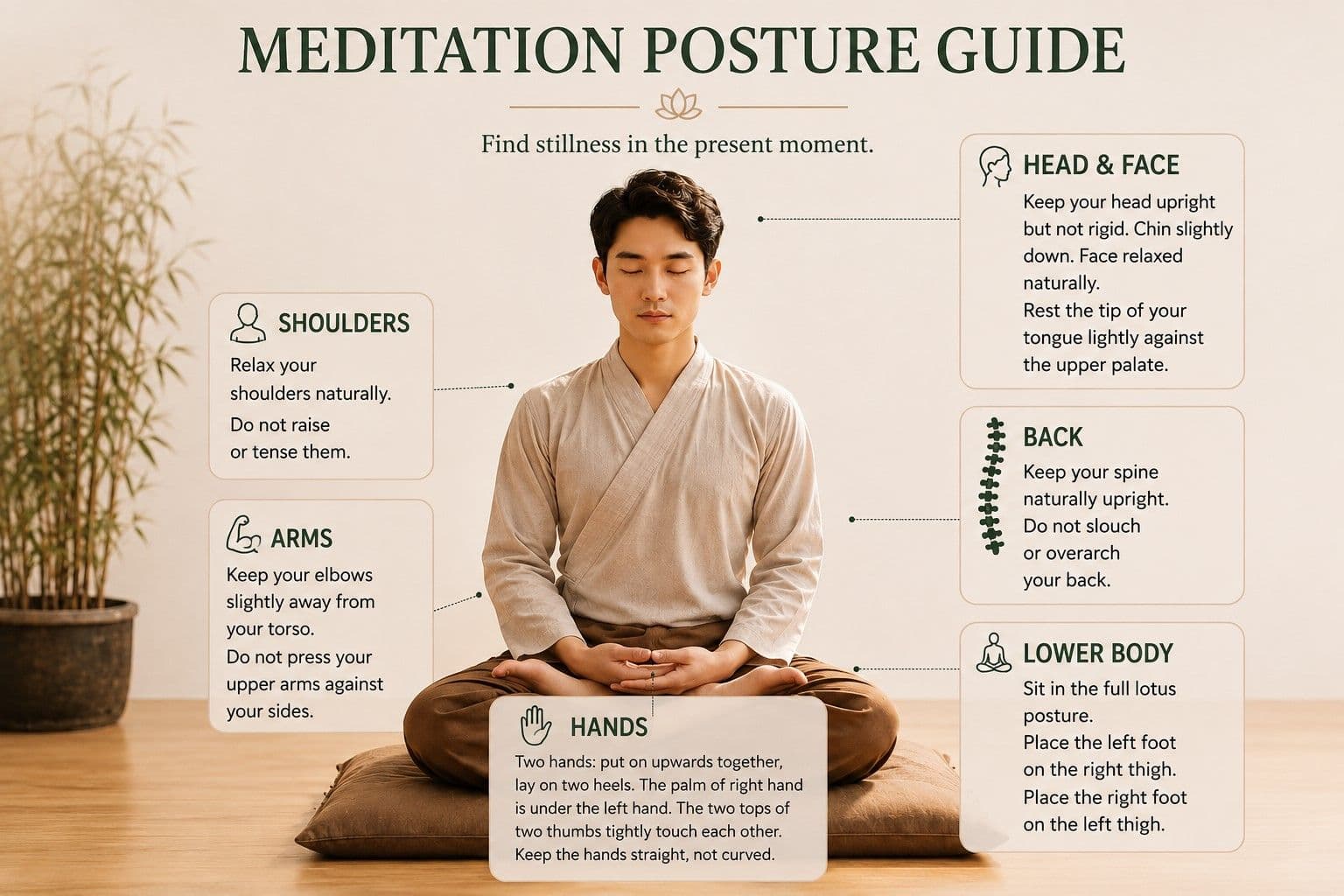
The left leg is put on the right leg, then the right leg is crossed the left leg. The feet are laid on the two thighs, not too close to or too far the hip.
3. A prayer before meditating
When being in right solemn position, practitioners should clasp the hands and recite a prayer (if you practice meditation alone you can recite it in whisper. If you practice in the assembly you need to read it loudly in chorus.)
May our Saints help us
Always memorize and know that
Body is not a self
Mind is not a self
Nothing is a self
In every breath in
In every breath out
Absolute homage to the Saints.
4. Take a vow of creating three merits
(After creciting the prayer and praying practitioners still clasp the hands, and take a vow of doing three good conducts in silence)
- May the Saints help me know how to lay homage to the all the Founders, and the Saints with the deep respect.
- May the Saints help me know how to love all beings in the visible world and also the invisible world. May I love human beings, and animals in forest, and fish in water, and beings in hell, and also plants and trees.
- May the Saints help me keep myself modest, and always think of myself as small as dust.
(If you are monks, you need to take another vow) - I take a vow that I determine to keep myself purification.
After that, practitioners begin to practice control of body.
5. Control of the body
a. Right positions
- Two hands: put on upwards together, lay on two heels. The palm of right hand is under the left hand. The two tops of two thumbs tightly touch each other. Keep the hands straight, not curved.
- Eyes: are open clear, look down to a point close to your face. At the first phase of practice, practitioners shouldn’t absolutely close the eyes. Only when your eyes are open can you see your body shaking or not, sinking to one side or not, compare with the scene around you. When you achieve the right mindfulness and awakening, you can never fall into unconsciousness, and then you can close your eyes.
- The tougue: touches to the upper teeth.
- The mouth: is close naturally/
- The back: need to be kept straight, not bent nor outstretched too much that it can make you tired, and strained.
- The shoulders: dropped down naturally. They must be the same height, not lean to one side.
- The two arms: spread out the elbows a bit far from hips. They must not press against hips.
- The head: don’t hold up, a little down. It shouldn’t lean to one side or turn to one side.
b. Conscious of the whole body
Your mind shouls always control the whold body. You must be conscious from head to feet. You should check the back if it is bent, and the shoulders if they are imbalanced, and the head if it is one-sided, and the hands if they are beautifully straight, and the arms if they are pressing against the hips, the eyes if they are looking at another point, the body if it is bent forward or backward. You must be always conscious of the whole body. It must be completely relaxed. If any part of the body is wrong position, it must be known well so that it can be adjusted immediately.
c. Keep the body soft and still
Along with being conscious of the whole body, you should relax your body. You also need to keep it soft and still.
You should always check any part of the body it it is moved or tense, and the whole body if it is soft and still or not. Every muscle, finger, toe, and thigh must be still.
You should always control the whole body, because when you sit motionlessly for a while, any muscle will be tense naturally, then you must get to know and relax it immediately/
Such the usual checking is to practice control of the body.
Noted:
When you are conscious of the whole body, you should be conscious of the belly and legs. You have to know it smoothly. You don’t pay attention to knowing it smoothly. You don’t pay attention to knowing it or press to mind it. If you pay much attention to it, then your energy will go up to your brain and you will be strained.
You shouldn’t be vague about it. If you’re not conscious of the whole body, when erroneous thinking appears in your mind, you can’t know it and you will easily fall into unconsciousness.
When erroneous thinking appears in your mind, you don’t need to destroy it, you only need to turn back to being conscious of the whold body and checking all the parts of body, and then erroneous thinking will disappear.
If erroneous thinking appears in you mind, then you turn back to being conscious of the whole body and checking all the parts of body, but the erroneous thinking doesn’t disappear, you should know that it is your karma. You should sincerely repent of your misdeeds. When your mind is quiet, you can turn back to checking your body.
6. Contemplating the impermanence of the body
After some minutes watching your body, you can think of yourself that “this body is impermanent”. Sometimes, you should remind yourself this sentence. You have to see the change of body, from young to old, from old to dead, from dead to reducing it to ashes. The Buddha taught that when we contemplate how the body is impermanent we must fully understand its impermanece. We only contemplate our own body (not someone else’s) that will be reduced to ashes one day.
After three days, the corpe will be swollen. After ten days, it will be smelt bad and attacked by maggots. After one month, its cells with be decomposed, and its apperancce looks terrible, then nobody dares to come close to it. Fifteen days later, the body will be dry after a period of disintergration. One moth after that, it will be reduced to a skeleton. Then time passes, it will be reduced to ashes that will be blown away by wind.
(You must practice contemplating the impermanence of the body in details throughout a few months before you practice contemplating breath)
7. Contemplating breath
After you master control of body, contemplation of the impermanent body, you can practice contemplating breath.
You know well when your breath is in or out, but you should not interfere in or control it.
When your breath is in, you know well it’s in.
When your breath is out, you know well it’s out.
When your breath is in and long, you know well it’s in and long.
When your breath is out and long, you know well it’s out and long.
When your breath is in and short, you know well it’s in and short.
When your breath is out and short, you know well it’s out and short.
It means that you know well how long or short your breath is. However, the key point here is that you should never interfere in your breath or control it as you want it to be. It’s simply you should know it as it is. Sometimes, it’s long, another time it’s short, the other time it’s soft, some other time it’s strong. You need to know it well, but never interfere in.
There are two extremes those you need to avoid:
- First, you don’t know well how your breath is.
- Second, you know it well and you interfere in.
The golden mean of contemplating breath is that you know it in passivity. You don’t have to control it or interfere in.
8. Going out of meditation and dedicating merit to all beings.
When going out of meditation, you should recite two prayers: (if sitting alone, you only recite them in whisper. If sitting with the assembly, you recite them loudly in chorus.)
The prayer of going out of meditation
May the Three Gems help me
When wakening and sleeping
All days and nights
Know my body to be impermanent
When going or standing
When sitting or lying
When working or resting
Know my body to be impermanent
When listening or talking
When being alone or in crowds
When reading or watching in movie
Know my body to be impermanent
When eating or drinking
When bathing or drying
When dressing or taking on
Know my body to be impermanent
The more conscious I am
The more I know it to be impermanent
May all beings in the world
Know their bodies to be impermanent.
(Next, recite the prayer of dedicating merit to all beings.)
May all realm and beings
Make effort to practice together
Free from ego and ignorance
We’ll attain enlightenment all together.
(Next, there are some gentle movements of massage)
- Raising up and haing down the head five times
- Turning the head slowly in to-an-fro five times.
- Moving the shoulders up and down in circle five times, and turning them back five times.
- Massaging chest, stomach, rib, and back.
- Pulling the legs and massaging them gently.
- After that, sitting on the spot for a while to relax.
(Next going for a walk)
9. Going for a walk
When going for a walk you still need to keep your mind in peace as you do meditate.
- Knowing the whole body.
- Comtemplating the impermanence of the body.
Written by:
Janna
Related Articles:
What Is Meditation? The Path to Inner Peace, Awakening & Liberation
The Appearance of the Awareness State | Meditation
The Peace of Mind – Meditation, Morality and Inner Peace
The Three Phases of Meditation
Answering Questions of Meditation – Part 1: Merit, Morality & Impermanence
Answering Questions of Meditation – Part 2: Erroneous Thinking
Coming to This Life: Why Are We Here?