
Explore Questions 21–25 on Buddhism,
covering whether non-Buddhists can attain Nirvana, the right way to practice, the Four Noble Truths, suffering, and the causes of suffering.
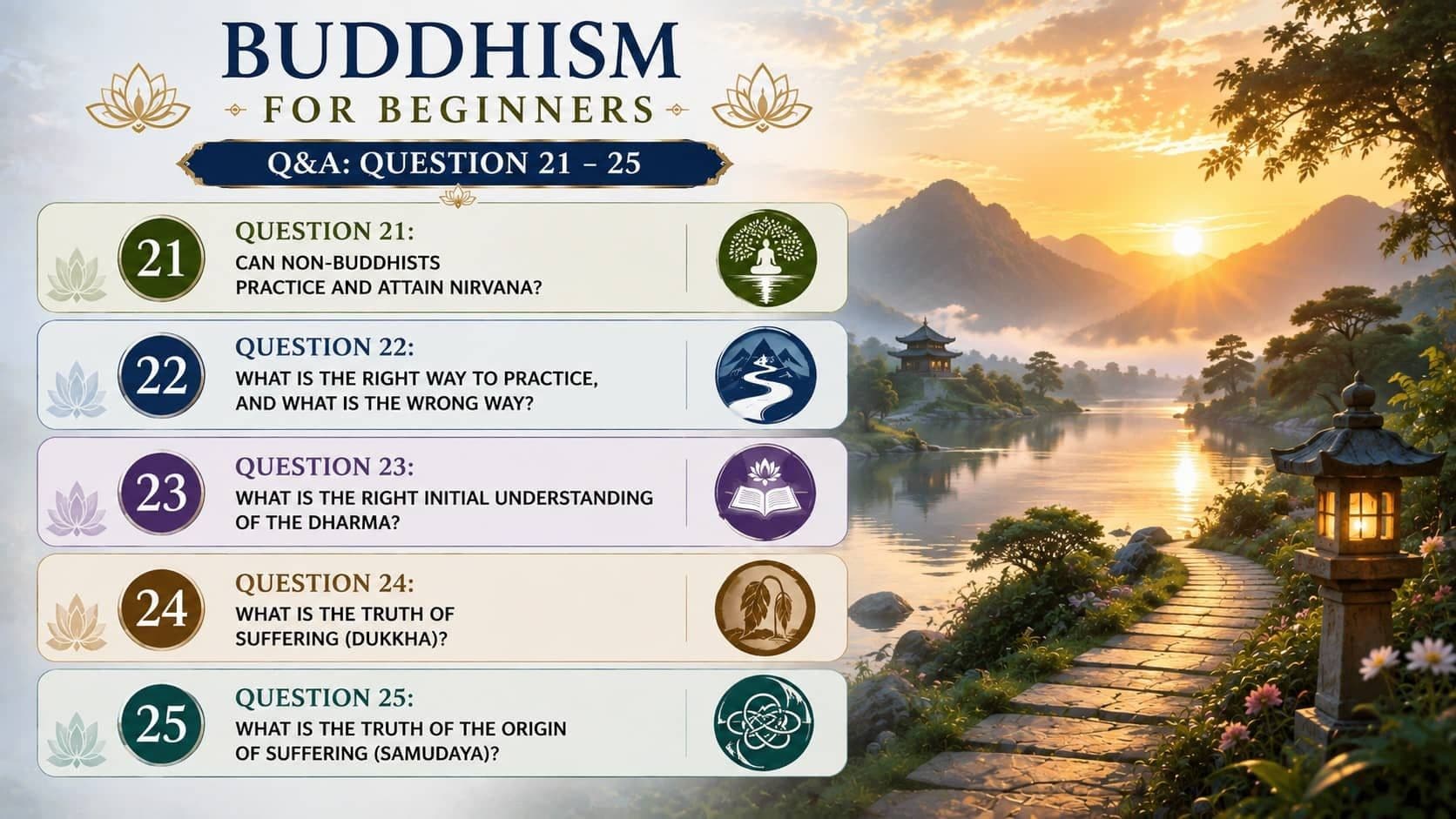
BUDDHISM FOR BEGINNERS – Q&A: QUESTION 21 – 25
Question 21: CAN NON-BUDDHISTS PRACTICE AND ATTAIN NIRVANA?
Answer: Ordinary people often find ways and reasons to divide themselves based on religion, skin color, race, boundaries, and possessions. However, Enlightened Beings do not concern themselves with these distinctions. They only differentiate between those who are virtuous and those who lack virtue. If we are virtuous, no matter what religion we belong to, the Enlightened Beings will hold us in high regard.
The Enlightened Ones are pleased when a Buddhist reveres Jesus, and equally pleased when a Christian reveres the Buddha. Truth transcends all boundaries and is not hindered by labels.
If a Buddhist practices incorrectly, they will not achieve any results. Conversely, if a non-Buddhist practices correctly, they can still achieve enlightenment.
Question 22: WHAT IS THE RIGHT WAY TO PRACTICE, AND WHAT IS THE WRONG WAY?
Answer: The path of spiritual practice in Buddhism is an extensive, detailed, and meticulous system of doctrines. It begins with having the right understanding of everything, followed by a challenging practice that progresses from shallow to deep, from small to large, and from near to far, requiring practitioners to prepare themselves mentally to follow this path over many lifetimes.
If one rushes into practice without fully understanding the principles and the path, they are likely to practice incorrectly. The first step is to gain a precise understanding of the teachings (Dharma) and the path itself. To achieve the right and complete understanding, one must pray to meet a true and wise master (*) and find the most authentic materials of Dharma. Since we ourselves do not yet have the wisdom to discern who is a truly wise master or which texts are authentic; we must humbly pray for Divine Beings’ guidance rather than arrogantly assume that we can judge which master is right or wrong, as all masters may sound convincing.
(*) master in Buddhism refers to a highly advanced practitioner who has attained deep insight, wisdom, and realization of the Dharma (Buddha's teachings) and is capable of guiding others on the path to enlightenment.
Question 23: WHAT IS THE RIGHT INITIAL UNDERSTANDING OF THE DHARMA?
Answer: The initial understanding of the Dharma must be thorough and profound, focusing on the Four Noble Truths. These truths are considered the declaration of Buddhism, which is great and profound, therefore, it can be very challenging to understand. Despite that difficulty, we must strive to comprehend it to begin our spiritual practice which spans many lifetimes.
The Four Noble Truths consist of the following:
-
The Truth of Suffering (Dukkha): The truth about the inherent nature of suffering in all beings and life itself.
-
The Truth of the Cause of Suffering (Samudaya): The truth about the origins of suffering and what causes suffering that pervades all aspects of life.
-
The Truth of the Cessation of Suffering (Nirodha): The truth about Nirvana, the state of absolute Enlightenment and extraordinary liberation free from suffering and rebirth, which is the ultimate goal of Buddhist practice.
-
The Truth of the Path Leading to the Cessation of Suffering (Magga): The truth about the path to the transcendent Nirvana, which includes the Noble Eightfold Path.
After meditating in the immovable lotus position for 49 days and nights in the forest of Uruvela, the Buddha attained supreme enlightenment. He then sought out the group of five ascetics led by Kondanna who were residing at the Deer Park (Sarnath) near Benares, to guide them. There, he delivered his first sermon on the Four Noble Truths, marking the beginning of all Buddhist teachings and representing the fundamental Truth of the universe.
The Truths seen through the Buddha's enlightened wisdom are not easy to understand. However, if we wish to practice correctly, we must grasp these Four Noble Truths.
Question 24: WHAT IS THE TRUTH OF SUFFERING (DUKKHA)?
Answer: The Truth of Suffering (Dukkha) refers to the fact of suffering. The universe is governed by many laws and principles related to physics, chemistry, mathematics, biology, and other fields. However, when it comes to sentient beings, those with consciousness, all inevitably face the harsh fact that all beings suffer in one way or another.
We might feel that we are okay and not sense any suffering, much like an ant foraging for food, a fish swimming in the water, or a worm burrowing underground, all seemingly without suffering. This is because we have become accustomed to suffering, accepting it as part of life and enduring it to survive. However, those in the higher realm can see our suffering, just as we see insects and animals struggling to survive and feel compassion for them.
The Enlightened Ones, such as the Arahants who have achieved absolute liberation, see clearly that all beings struggle and suffer, constantly striving to live, just to eventually die, which seems ultimately meaningless. If someone has a virtuous heart and lives selflessly, serving and caring for others, even though their life is still suffering, it carries more meaning. Conversely, those who live selfishly only add to their suffering.
The Buddha summarized suffering into eight types:
- The suffering of unfulfilled desires: Beings continually seek but never fully attain their wishes.
- The suffering of separation from loved ones: We are parted from the people or things we love since nothing in this world stays together forever.
- The suffering of encountering the unpleasant: Annoying and hated things follow us persistently.
- The suffering of birth: Life itself is a difficult journey.
- The suffering of ageing: The decay and decline caused by ageing are challenging.
- The suffering of illness: Physical ailments cause numerous troubles that no one can avoid.
- The suffering of death: The end of life brings pain, loss, separation, and regret.
- The suffering of mental disturbance: Mental turmoil is extremely distressing.
Occasionally, we may experience success and good luck, making us feel happy. These fleeting joys are the good karmic results of our past virtuous deeds. But when the blessing runs out, suffering returns. Continuously doing good deeds can prevent suffering but does not eliminate its root cause. Only by practicing the path towards liberation as taught by the Buddha can we completely eradicate the root of suffering.
Our brains are inherently inclined toward sadness, but due to the merit we have, our brain cells secrete dopamine to mask this sadness. When they stop secreting dopamine, we will fall into inescapable sadness or depression.
Our body is naturally inclined to pain, as muscles and joints constantly exert pressure on each other, causing discomfort. Due to our merit, the body's cells secrete endorphins to mask the pain. Without merit, endorphins cease being produced, then the body becomes filled with pain.
The suffering of sentient beings is endless, reflecting the nature of life itself.
Question 25: WHAT IS THE TRUTH OF THE ORIGIN OF SUFFERING (SAMUDAYA)?
Answer: The Truth of the Origin of Suffering (Samudaya) refers to the causes of suffering. Why are we born into this world and endure so much hardship, conflict, separation, loss, grief and despair while joys seem fleeting and temporary?
The root cause of all suffering lies in our ignorance (avijjā), attachment to the self (ego), craving, anger, deceit, ambition, foolishness, misunderstandings, arrogance, and selfishness. It is because of our faults that we experience suffering.
The greatest fault is ignorance. Ignorance leads to ego-clinging and craving, trapping us in the endless cycles of birth and rebirth (samsara).
Ignorance is difficult to define because ignorance is a profound state of darkness and foolishness that ordinary beings cannot perceive. Only enlightened Arahants truly understand what ignorance is upon reaching enlightenment.
Suffering is created by two forces: psychological feelings and the pressure of karma.
Karma places us in difficult circumstances, and our minds suffer in those circumstances. For example, karma might cause us to have a car accident, leading to loss and disruption, and our minds suffer due to the accident. However, a person with a tranquil and detached mind may experience the same accident with physical pain but his mind remains free from distress and sorrow. The primary cause of suffering is the mind, but external circumstances can influence the mind.
When our minds are filled with ignorance, ego-clinging, and desire, we cannot control our emotions when facing difficult situations.
When our minds are still dominated by ignorance, ego-clinging, desire, and anger, we cannot stop creating negative karma, and its consequences will push us into miserable situations.
As long as our minds are filled with ignorance, ego-clinging, and desire, the cycle of rebirth continues, forcing us to endure endless suffering.
Ignorance is pervasive, but the unwholesome instincts also create a vast sea of karma that traps beings within it. Beings have harmed, stolen, bound, slandered, deceived, betrayed each other, disrespected the noble saints, idolized the unrighteous, wasted food and water, neglected those in need, looked down on the less fortunate, arrogantly considered themselves superior, and acted irresponsibly toward those around them… Countless karmic debts force beings to return and face their consequences to settle them fully.
There is even karma that causes beings to be reborn as insects or worms with little hope of regaining human form, making the path to enlightenment seem hopeless.
Occasionally, through learning moral teachings, beings create good karma, helping one another, and this merit offers them more choices in life, making their living more comfortable. However, as long as ignorance persists, negative karma is always lurking; just a slight misstep creates negative karma, leading to further suffering.
Ignorance and unwholesome instincts (fetters) are ever-present, while virtue requires cultivation, maintenance, and effort, yet is easily lost.
Suffering is difficult to eliminate because its causes - ignorance, ego attachment, and craving - are constantly present.
Written by:
Janna
Related Articles:
Buddhism Questions 16–20: Heaven, Karma, Nirvana & Enlightenment
Questions 11–15: Karma, Reincarnation and the Six Realms
Buddhism for Beginners – Q&A: Questions 6–10 | Karma
Buddhism for Beginners – Basic Teachings and Beliefs – Q&A 1–5
A Wholesome Mind Creates Merit Without Intention
Instruction on Meditation: Essential Methods and Practice Guide
Part II – The Phase of Hard Practice | Right Effort in Meditation