
Explore Buddhist teachings on rebirth between realms, karma, merit,
prayer, deities, and how morality influences our spiritual journey in Questions 36–40.
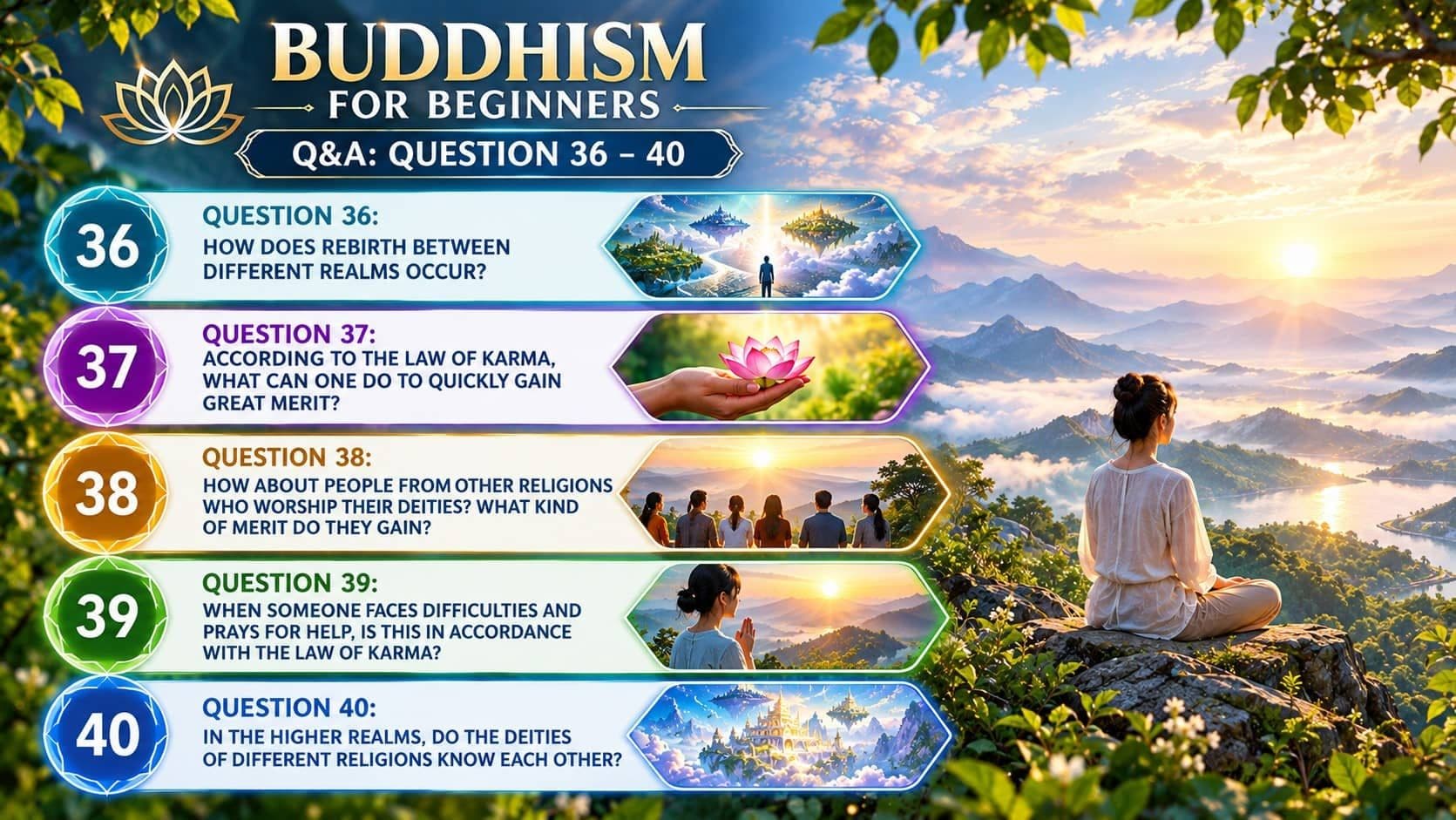
BUDDHISM FOR BEGINNERS – Q&A: QUESTION 36 – 40
Question 36: HOW DOES REBIRTH BETWEEN DIFFERENT REALMS OCCUR?
Answer: Beings are reborn into realms that correspond to their karma.
For example, those with great merit are reborn into the Human realm or ascend to the Heaven realms. Those with many sins descend to the Animal realm, the realm of Hungry ghosts, or the Hell realm. Those who have merit but retain sensual desires are reborn in the Heavens of the Desire Realm. Those who have merit and have overcome sensual desires are reborn in the Form Realm.
Many Celestial Beings in the Desire Realm are reborn as humans when their lifespan ends. The lifespan in the Heaven realms is proportional to the level of the heaven, ranging from several hundred years to millions of years.
Question 37: ACCORDING TO THE LAW OF KARMA, WHAT CAN ONE DO TO QUICKLY GAIN GREAT MERIT?
Answer: The greatest merit comes from guiding, supporting, and helping sentient beings in their spiritual practice to achieve enlightenment. However, to become a master with enough virtue and wisdom to instruct others, one must already have accumulated substantial merit in the past, so it is not easy to quickly achieve such great merit.
A bit easier way is to explain the Law of Karma to others. Those who can teach correctly about Karma will gain significant merit. Still, to effectively teach the Law of Karma, one must have personal cultivation, credibility, a virtuous life to serve as an example and significant merit. Without prior merit, one’s words may not be heeded and respected.
An even simpler way is to show reverence to the Buddha and the Enlightened Ones. This does not require interaction with others or any difficult conditions, just a sincere heart filled with reverence for the Buddha and the enlightened Saints. However, to develop such reverence, one must study and practice extensively, as it is not a simple task.
Question 38: HOW ABOUT PEOPLE FROM OTHER RELIGIONS WHO WORSHIP THEIR DEITIES? WHAT KIND OF MERIT DO THEY GAIN?
Answer: This depends on the nature of the deity in that religion. If the deity is an Enlightened One, then revering them can bring great merit. However, if the deity does not possess qualities of enlightenment, then worship may not result in as much merit as expected.\
Many followers believe that their deities reside in the heavens and have the power to bestow blessings or punishment, so they sincerely pray to receive blessings and hope to be welcomed into heaven after death. Some devotees sincerely pray and experience positive outcomes, while others fervently pray but see no results, leading to doubt. This depends on individual merit; those with more merit may see their prayers answered, while those with less merit may not see any results.
Ultimately, the Law of Karma governs everything with its absolute fairness.
Question 39: WHEN SOMEONE FACES DIFFICULTIES AND PRAYS FOR HELP, IS THIS IN ACCORDANCE WITH THE LAW OF KARMA?
Answer: The Law of Karma is strict, yet it also allows for flexibility. For instance, if a person faces a bad karmic consequence, such as an accident, and prays to deities for protection, the deities can intervene: If the person in trouble has a sincere heart and has done good deeds, the deities may use their powers to help him overcome the danger, similar to how we may assist others in times of hardship. In this case, the person is essentially borrowing merit from the deities, which means that they must repay this merit from their own good deeds in the future instead of enjoying it as they usually would.
Conversely, if someone facing difficulties does not perform good deeds and merely waits for help, they may find that in times of trouble, no assistance is forthcoming and their prayers go unanswered.
Question 40: IN THE HIGHER REALMS, DO THE DEITIES OF DIFFERENT RELIGIONS KNOW EACH OTHER?
Answer: Most deities are created by human imagination, so followers often do not have a clear understanding of what these deities are truly like and simply believe what they have been told. Each religion has its own deities due to the differing perspectives of its religious leaders. If these leaders achieve enlightenment and can perceive the heavenly realms clearly, they will understand the deities as unified and harmonious, without division by religion.
In the human realm, we tend to distinguish between people of different religions, but in the higher realms, deities only differentiate between those who are virtuous and those who are not. The deities do not require human beings to know them accurately to offer assistance; instead, they decide to help based on people's morality and virtue.
Written by:
Janna
Related Articles:
Buddhism for Beginners – Q&A: Questions 31–35 | Spirits, Merit.
Buddhism for Beginners Q&A: Questions 26–30 – Suffering, Liberation
Buddhism Q&A 21–25: Nirvana and the Four Noble Truths
Buddhism Questions 16–20: Heaven, Karma, Nirvana & Enlightenment
Questions 11–15: Karma, Reincarnation and the Six Realms
Buddhism for Beginners – Q&A: Questions 6–10 | Karma
Buddhism for Beginners – Basic Teachings and Beliefs – Q&A 1–5
Instruction on Meditation: Essential Methods and Practice Guide