
Explore Buddhism Questions 16–20 about the Kings of Heaven,
the origin of the universe, Buddhist goals, Nirvana, karma, merit, and the path to enlightenment.
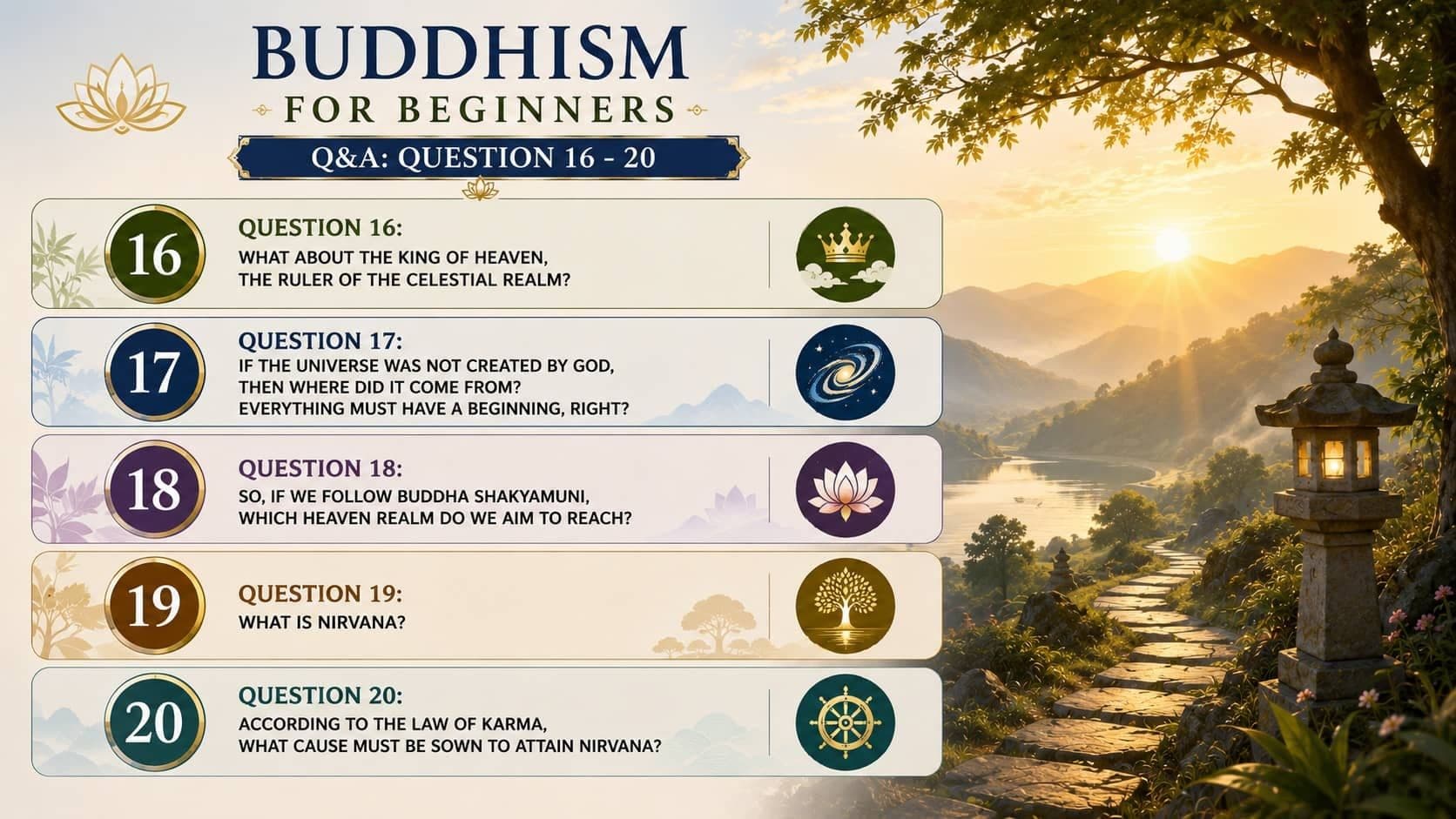
BUDDHISM FOR BEGINNERS – Q&A: QUESTION 16 – 20
Question 16: WHAT ABOUT THE KING OF HEAVEN, THE RULER OF THE CELESTIAL REALM?
Answer: Each Heaven realm has a king who rules over it, known as the Lord of the Heaven. In the higher Heaven realms, the role of those Lords is less prominent because most Celestial Beings are already very enlightened, virtuous, and self-disciplined, requiring no supervision.
Most religions in the world believe in a single Lord of Heaven because they think there is only one Heaven realm. In reality, there are many Lords of Heaven, each ruling over a level of the Heaven realm.
Religions also often believe that the King of Heaven is the supreme One who created everything, including the heavens, earth, all beings, life itself, and the fate of every individual. Because they believe that there is only one omnipotent God who created everything, the only way is to pray to the Lord for blessings.
Some philosophical schools oppose this belief, arguing that if God created everything, then God also created suffering, war, disease, disasters, tsunamis, separation, grief and death. They find this illogical and believe that the only way is to create one's own destiny.
Buddhism views the Kings of Heaven differently. The Kings of Heaven are Celestial Beings with great merit and virtue, and a long lifespan, who rule over the Heaven realm and also oversee the Human realm. These Lords do not create everything but govern all, striving to guide humans and Celestial Beings toward the best possible path. This perspective is more reasonable and gentle.
Question 17: IF THE UNIVERSE WAS NOT CREATED BY GOD, THEN WHERE DID IT COME FROM? EVERYTHING MUST HAVE A BEGINNING, RIGHT?
Answer: In our limited perspective, within a small scope and short timeframe, we see that everything has a beginning and an end. Humans are born, grow up, age, and die. Trees grow tall and eventually wither and die. However, if we expand our view to the infinite, we realize that everything is merely transforming from one state to another. Nothing is truly created, and nothing truly disappears.
Water vapor condenses into clouds, which then precipitates as rain. Rainwater flows into rivers and streams, eventually reaching the sea, and then evaporates back into clouds.
A tree grows from a seed, becomes trunks, branches, leaves, flowers, and fruits, then withers, decays, and turns into nutrients in the soil to nourish other trees.
The entire universe operates in a similar way, with no true beginning or end. It merely changes from one state to another.
In this infinite transformation, the Law of Karma and the will of Divine Beings play significant roles. The universe changes primarily according to the karma of sentient beings, but there is also some intervention from Celestial Beings. This is why when we face difficulties due to past karma, sincere prayers with promises to do good deeds can lead Celestial Beings to intervene in our fate and help us overcome adversity.
For example, if we are suffering from a serious illness with no cure in sight, we might kneel and pray sincerely to the divine, asking for healing and promising to live virtuously and help others in the future. Surprisingly, our health may be improved for reasons unknown.
Question 18: SO, IF WE FOLLOW BUDDHA SHAKYAMUNI, WHICH HEAVEN REALM DO WE AIM TO REACH?
Answer: The goal of practicing Buddhism is Enlightenment and Liberation.
Enlightenment is the ultimate wisdom, understanding everything in the universe, comprehending the truth of the cosmos, knowing the workings of the Law of Karma, achieving perfect morality, possessing boundless compassion, and being free from any suffering. While sentient beings are ignorant, enlightenment is the end of ignorance. While sentient beings cling to the self (ego), enlightenment is the state of no-self (egolessness).
Liberation means no longer being subject to the cycle of birth and death (samsara) when one has attained the complete Nirvana of an Arahant (a fully Enlightened Being).
If Buddhist disciples have not yet achieved complete liberation, they will still be reborn in good realms, with little ignorance and suffering. They will continue their practice until they attain the Arahant state with the complete Nirvana.
Question 19: WHAT IS NIRVANA?
Answer: Nirvana is an absolute state where there is no more suffering, no more ignorance, no more attachment to the notion of self, no more rebirth, no more binding emotions, and no more disturbances of the mind. In other words, Nirvana is a state of absolute clarity, absolute wisdom, and absolute compassion. It involves a deep understanding of the Law of Karma, the past bad karma of sentient beings, and the cycle of rebirth for all.
Nirvana has no specific location because it is not bound by space or time, yet it encompasses all space and time within it.
Of course, Nirvana is not the same as the Heaven realm because it has no physical and visible form, but the Heaven realm is also not separate from Nirvana.
Nirvana is neither a point nor a realm, it is neither large nor small; all space is within it. Nirvana is neither a moment nor a long period of time, so it is neither fast nor slow, neither before nor after; neither past nor future, all time is within it.
Nirvana is the absolute tranquility that transcends any thought and language; only those who have attained it can truly know it. The more one tries to describe Nirvana, the more mistaken one becomes, as it only leads to futile imagination.
The Enlightened Ones focus on teaching us the path to Nirvana, never attempting to describe it. Nirvana is extremely abstract, so those with lesser wisdom cannot perceive it and therefore will not aspire to attain it. Only those with great wisdom, who have revered and served the enlightened Saints in many past lives, can sense the sublime nature of Nirvana and aspire to achieve Enlightenment.
Question 20: ACCORDING TO THE LAW OF KARMA, WHAT CAUSE MUST BE SOWN TO ATTAIN NIRVANA?
Answer: According to the Law of Karma, "honoring teachers enables one to become a teacher". Therefore, those who revere enlightened Saints will have the blessing to practice and attain the supreme enlightenment and transcendent Nirvana. However, the level of reverence determines the degree of Enlightenment achieved. Absolute reverence leads to complete enlightenment and full attainment of Nirvana, while partial reverence results in partial enlightenment.
Additionally, reverence must be expressed through concrete actions such as praising, supporting, and making material offerings to the Enlightened Ones to create a more complete karmic result.
Another meritorious action that helps achieve enlightenment is to assist others in their spiritual practice towards enlightenment. To achieve something, one must first help others achieve it, making one’s own journey smoother. Generally, due to selfish tendencies, people only seek success for themselves and are unwilling to share good things with others, resulting in limited blessings (*). Be open to share the path to enlightenment with many people, our own practice will naturally become more favorable.
(*) blessing in Buddhism refers to the positive influence or favorable conditions that result from the accumulation of merit through good deeds, virtuous actions, and righteous speech. Blessing often manifests as well-being, wealth, success, good fortune, protection, or other favorable conditions in one's life. Merit and blessing are closely related but not identical. Merit is the cause, while blessings are often seen as the effect.
Written by:
Janna
Related Articles:
Questions 11–15: Karma, Reincarnation and the Six Realms
Buddhism for Beginners – Q&A: Questions 6–10 | Karma
Buddhism for Beginners – Basic Teachings and Beliefs – Q&A 1–5
Thinking You Are Right: The Wisdom of Recognizing Right and Wrong
A Wholesome Mind Creates Merit Without Intention
Instruction on Meditation: Essential Methods and Practice Guide
Three Foundations of Meditation – Morality, Merit and Qigong