
Explore Buddhism for Beginners Q&A Questions 31–35 about spirits of
the deceased, exorcism, merit, the goal of non-self, and the realms of existence in Buddhist cosmology.
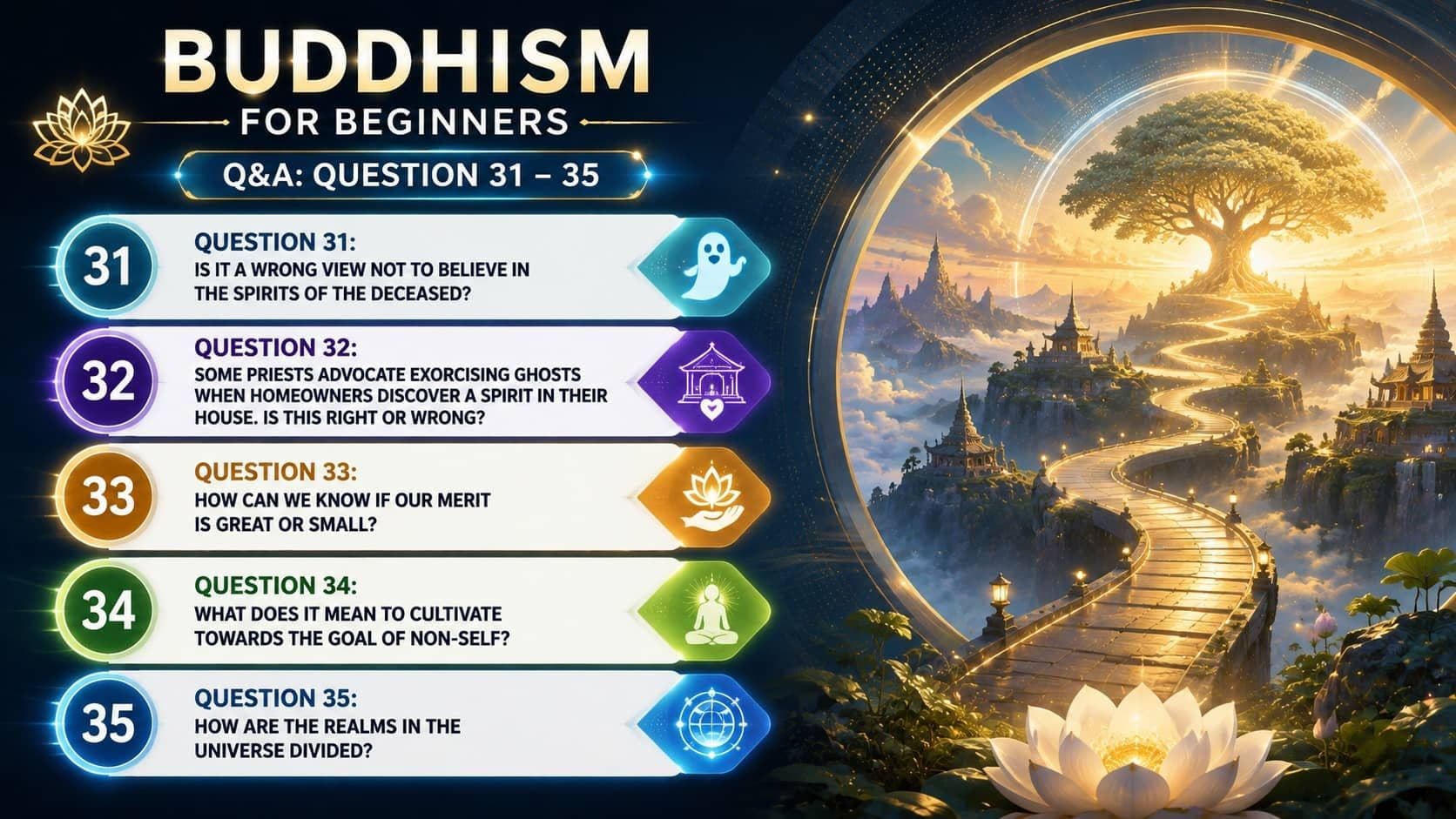
BUDDHISM FOR BEGINNERS – Q&A: QUESTION 31 – 35
Question 31: IS IT A WRONG VIEW NOT TO BELIEVE IN THE SPIRITS OF THE DECEASED?
Answer: According to the Nikaya scriptures, the Buddha taught that not believing in the existence of the spiritual realm (transmigration) is considered a wrong view. We do not need to wait until death to understand this truth. By calmly reflecting, we can realize that death is not the end but a transition from one state to another. Before death, people live in their physical bodies; after death, they continue to exist as invisible spirits. This transition is a natural process.
However, because these spirits are invisible, we tend to forget them, inadvertently disrespecting them. We have to understand them with wisdom rather than just our physical senses, much like understanding electronic machinery requires knowledge and intelligence beyond what the eyes can see. Nowadays, many cameras with high sensitivity have captured images of spirits in various places, which reinforces the belief in their presence.
We should understand them to have the appropriate respect and offer them food to help alleviate their hunger, as many wandering spirits suffer from hunger for a long time, similar to the impoverished people in this physical world. They can still benefit from the food we offer.
Additionally, we can recite sacred sutras and prayers for them as a spiritual gift to these beings.
Question 32: SOME PRIESTS ADVOCATE EXORCISING GHOSTS WHEN HOMEOWNERS DISCOVER A SPIRIT IN THEIR HOUSE. IS THIS RIGHT OR WRONG?
Answer: Spirits, like humans, can be categorized based on their merit: some have great merit, while others have little. Spirits with more merit have proper places to reside, while those with less merit wander in hunger and coldness. The temperament of spirits also varies; some are gentle, while others may be more aggressive. When spirits show signs of their presence, it does not necessarily mean they intend to harm. Sometimes, they might simply want to seek food from us or wish for prayers to help them escape suffering.
Unfortunately, many people misunderstand these signs and immediately call for exorcism to banish the spirits, which can offend and create animosity with them. Actually, we just need to offer them food and recite prayers or sutras, which can make them happy. Sometimes, they may even support us in our lives.
Question 33: HOW CAN WE KNOW IF OUR MERIT IS GREAT OR SMALL?
Answer: We carry a lot of negative karma from the past, which continues to influence us, while the positive karma we create in this life may not have yet matured into visible results, making it difficult to perceive our merit clearly. However, if we spend our lives doing good deeds, helping others, planting trees, digging wells, repairing roads, fixing neighbors' houses, building new homes for the community, helping children go to school, assisting the poor with medical care, paying taxes diligently, teaching others about the Law of Karma, encouraging moral development, and promoting love and compassion among people… we are likely to enjoy a peaceful and happy old age, which reflects some of our accumulated merit. After death, we may be reborn into a favorable realm, and if reborn as a human, we will have a noble status.
The concern is if we do too few good deeds in this life. If our blessing runs out before we die, we may face hardship and loneliness in old age and become a suffering spirit after death, taking a long time to be reborn into a lowly position.
Question 34: WHAT DOES IT MEAN TO CULTIVATE TOWARDS THE GOAL OF NON-SELF?
Answer: All sentient beings are influenced by the ego, which is the sense of self. This feeling of self is an illusion, but it governs human psychology. The larger the ego, the more a person becomes immoral, greedy, arrogant, aggressive, selfish, jealous, ambitious, and competitive.
Most wise masters advise people to diminish their egos to develop morality. The smaller the ego, the less unwholesome tendencies a person will have, making it easier to develop moral qualities such as humility, compassion, generosity, charity, tolerance, kindness, gentleness and patience.
However, only the Buddha taught complete non-self through the Noble Eightfold Path, with meditation as the core practice to overcome ego-attachment. Non-self means the absolute absence of the ego and the attachment to the self, leaving only a unified, boundless existence of all beings. This is the ultimate goal of Buddhist practice.
If we stray from the goal of non-self, no matter how much we practice, we cannot achieve liberation, as the ego is the chain that binds us to the endless suffering in samsara. The ego is so subtle and deceptive that even when we reach deep meditative states, it can deceive us, leading to pride. Even when we live virtuously, frequently helping others, it can lead us to feel pride in our good qualities. Therefore, in daily life, one must be wise and intelligent to avoid being deceived by the ego's hidden and insidious nature.
Question 35: HOW ARE THE REALMS IN THE UNIVERSE DIVIDED?
Answer: The realms of existence are divided in several ways:
When categorized by composition, the Human Realm and the Animal Realm are considered realms of visible matter, while the realms of Heaven, Demi-God, Hungry Ghosts, and Hell are realms of invisible spirits.
If divided by merit, the Animal, Hungry Ghost and Hell realms are characterized by low merit and high sin, where beings experience significant suffering. The Human realm is a mixed realm, where beings have both sin and merit, experiencing both happiness and suffering, while the realms of Heavens and Demi-Gods are realms of high merit, where beings enjoy great happiness and blessings.
If divided by psychophysiological characteristics, the Desire Realm includes six heavenly realms (The Heaven of Delight in Creation (Nirmāṇarati), the Heaven of Joyous Emanations (Parinirmita-vasavartin), the Heaven of Contentment (Tuṣita), the Yama Heaven (Yāma), the Heaven of the Thirty-Three (Trāyastriṃśa), the Heaven of the Four Great Kings (Cāturmahārājika). It also includes the Human realm, the Animal realm, the realm of hungry ghosts, and the hell realm. A defining characteristic of beings in the Desire Realm is that they still possess sensual desires.
Above the Desire Realm are the realms of the Form Realm. Here, the Celestial Beings possess very large forms but no longer have sensual desires. The Form Realm consists of 18 levels, which are actually divided into four stages of meditative concentration, from the First Jhana to the Fourth Jhana. Those who achieve the First Jhana or higher in their practice will be reborn in the Form Realm after leaving the Human realm.
Higher than the Form Realm is the Formless Realm, which comprises four levels. In this realm, deities have transcended both sensual desires and physical form, existing as pure, intangible consciousness.
The Buddhist cosmology is vast and thorough, offering a comprehensive understanding of the universe that surpasses any other religious or philosophical perspective.
Written by:
Janna
Related Articles:
Buddhism for Beginners Q&A: Questions 26–30 – Suffering, Liberation
Buddhism Q&A 21–25: Nirvana and the Four Noble Truths
Buddhism Questions 16–20: Heaven, Karma, Nirvana & Enlightenment
Questions 11–15: Karma, Reincarnation and the Six Realms
Buddhism for Beginners – Q&A: Questions 6–10 | Karma
Buddhism for Beginners – Basic Teachings and Beliefs – Q&A 1–5
Instruction on Meditation: Essential Methods and Practice Guide
Thoughts and the Awareness State – Part IV | Meditation Practice