
Buddhism for Beginners Q&A 61–65: Taking Refuge in Buddhism
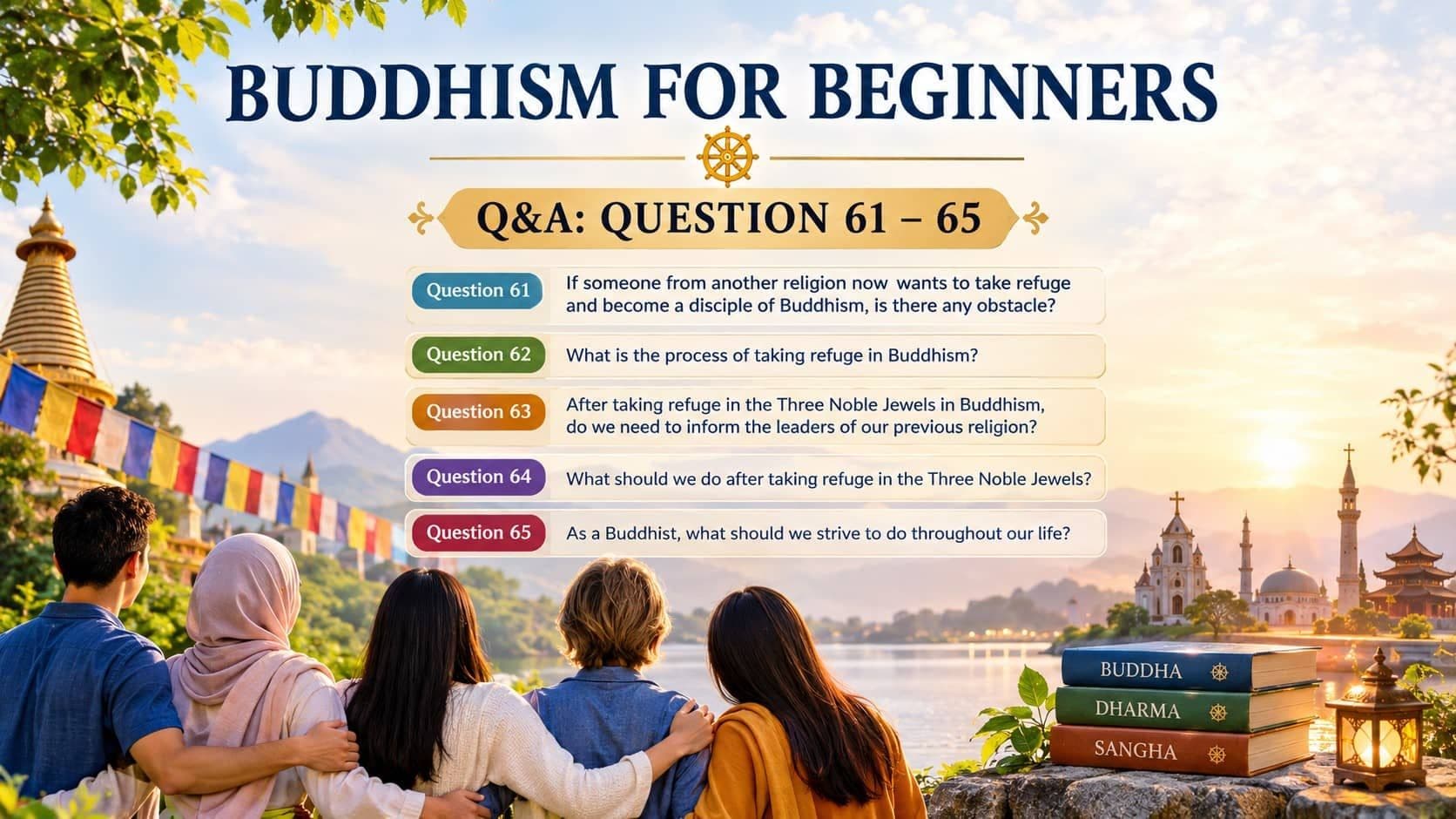
BUDDHISM FOR BEGINNERS – Q&A: QUESTION 61 – 65
Question 61: IF SOMEONE FROM ANOTHER RELIGION NOW WANTS TO TAKE REFUGE AND BECOME A DISCIPLE OF BUDDHISM, IS THERE ANY OBSTACLE?
Answer: We can ask a similar question to followers of other religions: if a Buddhist wants to become a follower of your religion, would there be any obstacles? The answer would most likely be: "No, there is no obstacle." The same goes for Buddhism – there is no obstacle for someone from another religion to take refuge and become a follower of Buddhism.
Many people embrace two or even three religions in their lifetime, and they still live happily, just like how people today can have multiple nationalities and the world still gets along just fine.
Moreover, having multiple religions might even contribute to a more united world, as long as religious leaders and followers maintain a positive outlook.
For example, if Christians wish to take refuge in Buddhism, they will have the opportunity to learn new teachings. This is not because they reject the Christian teachings they previously followed. By learning from different sources of teachings, they can wisely select and integrate the most appropriate approach to cultivate themselves more profoundly.
Question 62: WHAT IS THE PROCESS OF TAKING REFUGE IN BUDDHISM?
Answer: To take refuge and become a follower of Buddhism, you would follow these steps:
-
Choose a spiritual teacher (master) whom you trust and respect, someone who possesses the right qualities to guide you in the teachings of Buddhism over time.
-
After expressing your sincere wish to take refuge in Buddhism, your master will set a time and place to conduct the refuge ceremony.
-
During this ceremony, you will be guided to recite the Three Refuges: to take refuge in the Buddha, the Dharma (Buddha's teachings), and the Sangha (the community of the Buddha’s enlightened disciples). This means committing your life to seek refuge in, learning from, following and practicing according to these Three Noble Jewels of the universe: the Buddha, the Dharma, and the Sangha.
-
You will also be given the Five Basic Precepts, which are the foundational ethical guidelines for lay disciples in Buddhism.
• Do not kill or harm living beings (and instead, protect and nurture life).
• Do not steal (and instead, be generous and help others),
• Do not engage in sexual misconduct (and instead, be loyal and faithful in your relationships)
• Do not lie or speak harmful words (and instead, speak truthfully and share the Dharma with others)
• Do not use intoxicants (and instead, maintain a healthy body and mind).
- During the refuge ceremony, your master will provide some fundamental teachings to guide your practice.
From this moment on, you are officially a disciple of the Buddha, establishing a positive connection with the Buddha’s Dharma for countless lifetimes to come.
Question 63: AFTER TAKING REFUGE IN THE THREE NOBLE JEWELS IN BUDDHISM, DO WE NEED TO INFORM THE LEADERS OF OUR PREVIOUS RELIGION?
Answer: If we feel that these leaders are open-minded and cheerful, we may consider informing them about our decision. This can help strengthen the bond between the two religions, showing that we are not abandoning our previous religion, but rather adding Buddhism to our spiritual journey to promote greater love and unity in the world.
However, if we sense that they might not be very pleased, it may be best to wait for a more appropriate time.
We have chosen to take refuge in the Three Noble Jewels because we realize that Buddhism offers profound and peaceful teachings in a world filled with conflict, hatred, and separation. We seek refuge in Buddhism because we have found in it a bright path that can lead us far into the truth.
We do not take refuge in the Three Noble Jewels to create further division, discrimination, or animosity. Instead, we hope that one day all religions can come together, find common ground, and lead humanity towards the path of love and happiness.
Question 64: WHAT SHOULD WE DO AFTER TAKING REFUGE IN THE THREE NOBLE JEWELS?
Answer: Except for those with extraordinary spiritual capacity who can practice on their own and still attain enlightenment, known in Buddhism as Pratyekabuddhas (Self-enlightened Ones), everyone else must practice with fellow practitioners and follow a master closely over the long term. This helps us avoid laziness, complacency, and potential mistakes that could lead to regression. Therefore, it's essential to join a Buddhist fellowship to stay connected and committed to our practice.
The master may already have an established Buddhist fellowship community for lay disciples, in which case we can simply join. If the master does not have that community, we might consider asking for permission to form a self-managed practice community with other practitioners, where we may encourage and support each other in diligent practice.
In the path to enlightenment, engaging in charitable activities and accumulating merit is extremely important. No one can progress spiritually if lacking merit. However, there are some meritorious deeds beyond our individual capacity that cannot be accomplished alone. So working with a group makes them more feasible. By participating in a fellowship community, we will have more opportunities to engage in meaningful charitable activities.
Question 65: AS A BUDDHIST, WHAT SHOULD WE STRIVE TO DO THROUGHOUT OUR LIFE?
Answer: As Buddhists, we need to focus on cultivating morality and performing virtuous deeds. We’ve outlined various levels of meritorious deeds from basic to advanced. The most basic level involves helping others with their essential needs, such as food and clothing; the most advanced level involves supporting others in their spiritual practice toward enlightenment. While basic acts are about assisting people's everyday lives, advanced acts focus on supporting their spiritual and mental well-being.
In addition, we should actively seek opportunities in our daily lives to share the Buddha's teachings with others, helping them to understand these teachings alongside the beliefs they already hold. Buddhist teachings can serve as a wonderful supplement to the doctrines of other religions.
We often hold the prejudice that the teachings of one religion will contradict those of another. However, we should now adopt a different perspective: the teachings of one religion can complement and complete the teachings of another.
In summary, as Buddhists, we should spend the rest of our lives using the Buddha's teachings to connect religions, heal divisions, mend what has been broken, and spread love in places where there is still envy and hatred.
Written by:
Janna
Related Articles:
Buddhism for Beginners – Q&A Questions 56–60: Breath, Mindfulness
Buddhism for Beginners – Q&A: Questions 51–55
Buddhism for Beginners – Q&A: Questions 46–50
Buddhism for Beginners – Q&A: Questions 41–45 on Karma, Morality
Buddhism for Beginners – Q&A: Questions 36–40
Instruction on Meditation: Essential Methods and Practice Guide
Coming to This Life: Why Are We Here?
The Role of Qi Gong in Meditation Practice | Meditation Q&A 31