
Explore Questions 51–55 on Buddhist meditation, Right Endeavor,
mindfulness, body awareness, impermanence, and focusing on the lower abdomen.
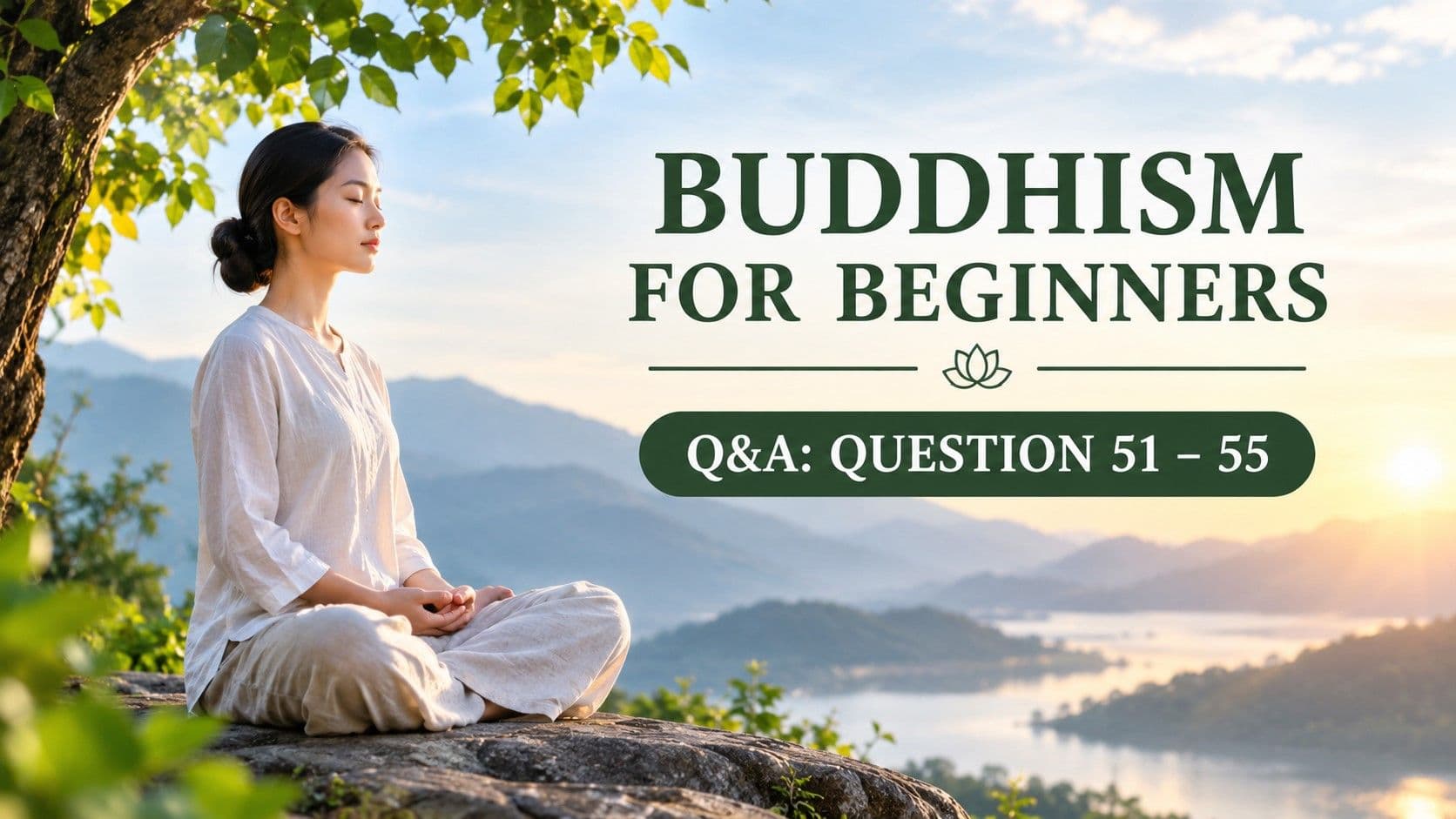
BUDDHISM FOR BEGINNERS – Q&A: QUESTION 51 – 55
Question 51: RIGHT ENDEAVOUR MEANS PRACTICING MEDITATION WITH THE CORRECT METHOD WITHOUT ACHIEVING RESULTS. HOW CAN THIS CONCEPT BE EXPLAINED FURTHER?
Answer: Even with the correct method, it is not easy for practitioners to achieve the desired results. This is like striking a rock with a hammer; we may hit it a hundred times without making any difference, but the 101st strike might suddenly break the rock. Practicing incorrectly can lead to psychological or neurological issues while practicing correctly does not guarantee immediate results. It requires sustained endeavor, often without any signs of progress. This persistent effort is called Right Endeavor.
In the Gospel, Jesus provided a metaphor that captures this idea: the bride on her wedding night must stay awake, not knowing when the groom will arrive. In ancient times, it might be considered blameworthy if the bride fell asleep before the groom arrived. Jesus used this custom to imply that enlightenment can come unexpectedly, so practitioners must continuously maintain their practice without interruption.
Success in meditation results from a combination of factors, including past merit, inner morality, accurate methods, and sustained effort over time.
Right Endeavor, as part of the Noble Eightfold Path, involves a prolonged period of effort with various challenges and struggles. When the mind is not yet calm, the body may become fatigued, the legs might ache and go numb, and sitting in meditation may be restless and frustrating. This is the time when strong willpower is essential. Those with weak willpower might feel discouraged and give up. Practitioners must cultivate a strong will – not tense, but gentle and firm enough to endure the discomfort and maintain long meditation sessions.
The strength of Right Endeavor is not outwardly expressed; it is not tense but incredibly gentle and determined.
Question 52: DURING THE STAGE OF RIGHT ENDEAVOR, WHEN THERE ARE NO RESULTS FROM MEDITATION YET, HOW SHOULD A PRACTITIONER HANDLE IT?
Answer: A practitioner typically needs to try various meditation methods rather than sticking to one method to achieve success. When we discuss the Four Foundations of Mindfulness later on, we will see that practitioners must gradually adjust their practice according to their increasingly deep levels of mindfulness.
When the mind lacks mindfulness, practitioners can easily be led astray by wandering thoughts, causing them to lose focus on their meditation practice. For instance, a practitioner might be focusing on his breath but when a thought arises, he would forget about the breath. Another might be contemplating the impermanence of the body but then gets distracted by thoughts and forgets the contemplation of impermanence…
Initially, a practitioner might have a bit of mindfulness, but it may not be strong enough to prevent subtle wandering thoughts from arising and diverting the mind.
We can outline the stages of practice as follows:
UNWHOLESOME MIND – MIXED WHOLESOME AND UNWHOLESOME MIND – PURELY WHOLESOME MIND – MINDFULNESS – DEEP MINDFULNESS (RIGHT MINDFULNESS) – ENTRY INTO FIRST JHANA
At the beginning, being aware that one is distracted by wandering thoughts is a form of mindfulness, but this mindfulness is still weak and not strong enough to prevent wandering thoughts from arising.
Mindfulness can be strengthened as merit increases and sins decrease, combined with the proper practice of contemplation. If mindfulness is weak, practitioners should step back and evaluate their merit and sin rather than hastily moving forward. We have different levels of self-assessment for our merit and sin, such as:
- This mind is heavily laden with karmic obstructions.
- This mind is filled with faults.
- This mind is still ordinary and harbours many faults.
- Deep within, this mind is still ignorant and sinful.
When we accurately recognize the true nature of the mind, our negative karma naturally diminishes, allowing the conditions for mindfulness to arise.
In general, practitioners need to make various adjustments (using correct techniques) during the stage of Right Endeavour to develop strong mindfulness, paving the way for deep meditation.
Question 53: WHY IS IT IMPORTANT TO BE AWARE OF THE WHOLE BODY AND THE SENSATION OF THE WHOLE BODY DURING MEDITATION?
Answer: Being aware of the chest and abdomen during meditation offers several benefits:
-
The skin covers a large area of the body, so when we focus our attention on the body, the entire surface of the skin is activated, creating a strong sense of mindfulness for the mind. In contrast, if we focus only on the head, the mindfulness generated is minimal and tends to weaken over time. The body generates mindfulness for the mind. This is a very special principle that the Buddha taught in the Nikaya scriptures: “Aware of the whole body, I breathe in; aware of the whole body, I breathe out."
-
Interestingly, wandering thoughts originate from the lower parts of the body, not from the brain. This surprising discovery comes from experienced meditation practitioners. When we focus only on the head, we are unable to prevent the sudden rise of wandering thoughts from the lower body. However, when we anchor our awareness in the lower body, we can stop wandering thoughts at their source. This is a fascinating insight into meditation.
-
Focusing attention on the lower body, especially deep down in the bottom of the abdomen, helps preserve the body's inner vital energy (Chân Âm). Typically, we tend to deplete this vital energy because we usually focus too much on the head from birth. Thoughts occur in the head, and the senses of sight and hearing are also concentrated there, gradually depleting this vital energy. During meditation, we should direct our attention to the lower body to restore this vital energy, which helps keep the mind awake, strengthens the internal organs, and significantly reduces distracting thoughts.
Question 54: WHY IS IT IMPORTANT TO THOROUGHLY CONTEMPLATE THE IMPERMANENCE OF THE BODY?
Answer: When we focus our attention on the body and become aware of it entirely, we gain increased mindfulness, which helps prevent distractions from wandering thoughts astray. However, as we direct our awareness to the body, an attachment to the body naturally arises, and we start to cherish the body more, which is a form of wrong view. Therefore, we must consciously contemplate that the body is impermanent, that it will age, fall ill, and eventually die. After death, the body will decay until nothing remains, not even the bones, which will also turn to dust.
By confronting the impermanence of the body, our attachment to it diminishes, as a result, our other desires also lessen. Attachment to the body is the foundation of ego-clinging; when our attachment to the body decreases, so does our attachment to the ego.
Contemplating the impermanence of the body not only reduces this attachment but also reinforces mindfulness. As we focus on the impermanence of the body, we simultaneously direct our attention to the lower body, further strengthening our mindfulness.
When we contemplate the impermanence of the body, we simultaneously maintain awareness of the body, which further strengthens mindfulness.
Later on, as mindfulness deepens and the mind becomes more tranquil, we will realize that the mind does not reside solely in the head; it encompasses the entire body.
Question 55: CAN YOU EXPLAIN THE BENEFITS OF FOCUSING ATTENTION ON THE BOTTOM OF ABDOMEN DURING MEDITATION?
Answer: According to the Buddha's teachings, practitioners should be aware of the entire body, but most of us tend to focus only on the chest and upper abdomen, rather than the bottom of the abdomen, which includes two important acupoints: the Dan Tian and the Hui Yin (you can refer to Google for their exact locations).
The Buddha mentioned in the Nikaya Sutras, " There is no part of the body where mindfulness is absent" Therefore, paying deep attention to the bottom of the abdomen is essential.
The Dan Tian acupoint helps increase the mind's mindfulness, but it may sometimes create illusions. The Hui Yin acupoint helps calm the mind, bringing it into deep concentration in meditation and eliminating illusions.
When we focus on the bottom of the abdomen, it means we are paying attention to an entire area that includes these two crucial acupoints. Additionally, focusing on the bottom of the abdomen can remind us of humility, keeping us aware that our merit, level of meditation, and spiritual aptitude are still very low and that we have much to learn.
Written by:
Janna
Related Articles:
Buddhism for Beginners – Q&A: Questions 46–50
Buddhism for Beginners – Q&A: Questions 41–45 on Karma, Morality
Buddhism for Beginners – Q&A: Questions 36–40
Buddhism for Beginners – Q&A: Questions 31–35 | Spirits, Merit.
Homelessness, Wealth, Karma, and the Value of Social Contribution
Instruction on Meditation: Essential Methods and Practice Guide
Imperfect: Identity, Meditation, Karma and the Search for Inner Peace