
When committing a crime,
we often think it is not a sin but try to avoid admitting guilt, oppose punishment and deny retribution. Thus, it is extremely hard to go against that kind of mentality. But we must educate, persuade them to admit their faults, gladly accept the punishment and believe in painful karmic retribution. Though it is difficult, we have to do it all to save their lives and help maintain the long-term stability of the society.
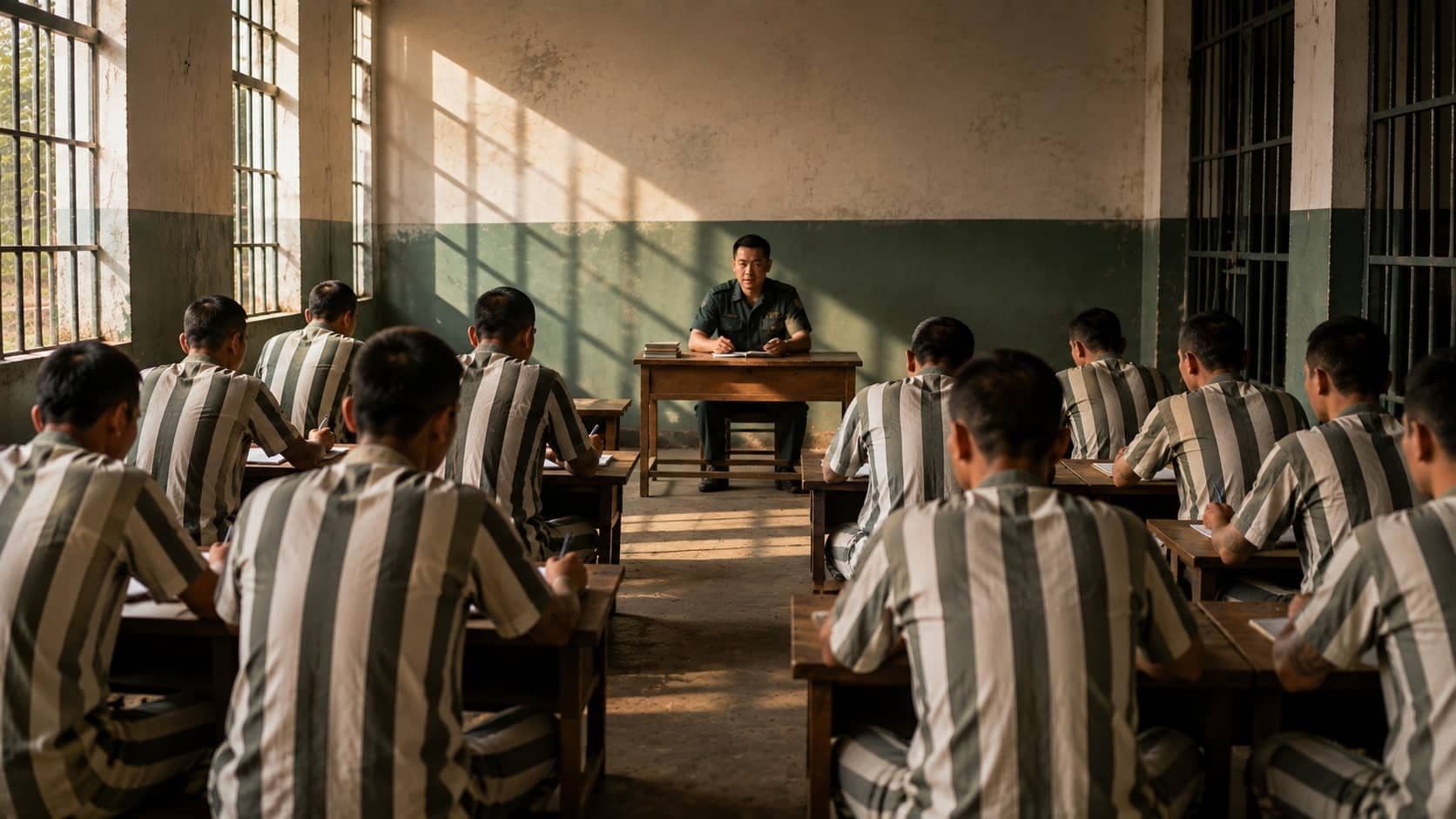
PRISONS
Standing on the balcony upstairs while watching the prisoners sunbathing, the Brigadier General asked the Director of the prison:
"Director, could you report the result of your moral education experiment on the prisoners? How is it going?"
The Director replied:
"Sir, one year after taking this position as Director of Detention Center H7, I realized that maintaining this prison costs a lot of money from the State budget, which comes from taxpayers. The more criminals there are in society, the more money we must spend. It doesn't make sense because one side has to pay for the other's crime."
"I also see that most prisons let prisoners do physical exercise to kill their free time. After being released, many prisoners have become much more dangerous. With extraordinary health but worse criminal records, these guys would earn the respect of other bad guys and soon become gangsters in the society. Tax money has helped create more criminals just like that."
"While in prison, secret gangs are formed to smuggle drugs. They even control jailers and run gangs outside.
Generally, the situation is extremely disadvantageous. I keep worrying about how to re-educate all prisoners effectively, so that they must be better than before imprisonment. The people's tax money should not be wasted for nothing."
"I looked for moral lessons everywhere, from both the Internet and books. It is fortunate that we now have the Law on Religion and Folk Belief, which allows prisoners to perform their religious rites. I also filtered the quintessence of morality from many religions. Amongst them, I found a very helpful page focusing on morality called THE FOUNDATIONS OF MORALITY."
"I also arranged the altars of many religions next to one another, so the prisoners could worship with a sense of national solidarity."
"I asked the board of jailers to re-compile those lessons into a moral textbook for the prisoners to learn. The subject of Law on Karma is extremely beneficial. Besides, I also introduced meditation into the program."
"After completing the moral textbook, I asked all jailers to discuss carefully with each other first. Then I reported to the Bureau and asked if we could teach the prisoners moral lessons. Luckily, the leaders agreed and encouraged us greatly. So I opened classes for the prisoners, with notes, tests, and evaluation of moral changes as well."
"After one year taking the class, the prisoners have improved remarkably. Debauchery has decreased significantly. Recently, several prisoners, who have just been released, cried and didn't want to go back home, as they were happier here and they felt lonely living outside. I had to comfort them so that they agreed to leave. Some of them still miss us and come back here to visit once in a while. They're able to adapt themselves very well to their community, with no sign of re-committing crime."
The Brigadier General nodded his head and said:
"I have also heard from private reports that your re-education program at Detention Center H7 has worked out effectively. Please submit a detailed report to the Bureau, and I will have it sent to the Ministry. It'd be great if the Ministry can get the Government's approval for nationwide application to all prisons."
In the past, criminals were punished by having their hands or feet cut off, which caused severe damage to the body. Today, living in a civilized society, criminals are only sent to prison as a punishment. There are two purposes for imprisonment. The first is to punish the criminals, the second is to keep them away from the society. These two purposes are not sufficient to re-educate the criminals. The criminals need to be taught some special moral lessons to change their lives entirely.
Prison is not a place where anger is vented, but the place where morality is taught. It is extremely difficult to teach morality to criminals because their starting points are quite lower than others. Therefore, the moral textbooks for criminals should be cleverly and efficiently organized. While it is difficult to teach morals to students, it is a hundred times more difficult to teach criminals moral lessons.
There are some criminal cases from which innocent people are unjustly punished, or by chance, they are related to others' crimes. There is no problem with their morality, but such cases are rare. Most criminals have moral problems. The criminal law defines the lack of morality as "fault." If such lack of morality cannot be completely solved, it will cause a lot of troubles in life.
When committing a crime, we often think it is not a sin but try to avoid admitting guilt, oppose punishment and deny retribution. Thus, it is extremely hard to go against that kind of mentality. But we must educate, persuade them to admit their faults, gladly accept the punishment and believe in painful karmic retribution. Though it is difficult, we have to do it all to save their lives and help maintain the long-term stability of the society.
Moreover, we must teach morals to criminals so that tax money from the people will not go to waste.
Written by:
Janna
Related Articles:
Gift – The Art of Giving with Respect and Kindness
Happiness: The Meaning of True Happiness, Morality and Meditation
Friendship – The Meaning of True Friendship
Spoken Words – The Power of Courtesy and Respect
Fear of Ghosts: How Love Can Overcome Fear
Instruction on Meditation: Essential Methods and Practice Guide
Three Foundations of Meditation – Morality, Merit and Qigong