
Janna · Aug 25, 2026
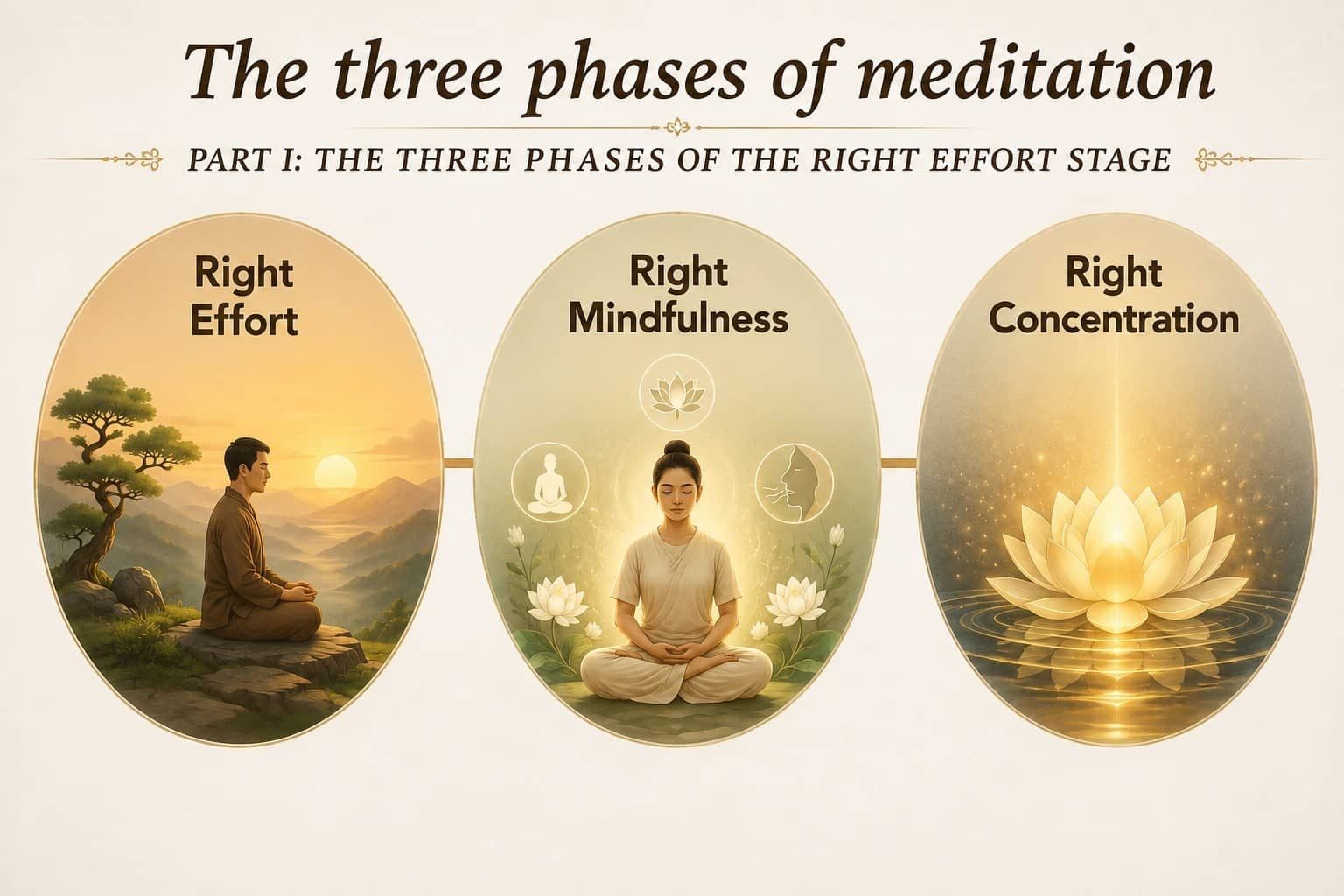
THE THREE PHASES OF MEDITATION
PART I: RIGHT EFFORT – PART 2: RIGHT MINDFULNESS – PART III: RIGHT CONCENTRATION
PART I: THE THREE PHASES OF THE RIGHT EFFORT STAGE
The Right Effort is to make an effort to practice meditation, though you may gain nothing. You will find it very difficult to be at this stage with your sore legs, bodily fatigue, chaotic mind, sleepiness, restraint, depression, etc. And you must use your will to overcome those difficulties. But thanks to your blessings, virtue of keeping the Precepts, being careful with errors, and especially “seeing the danger in every small mistake," your determination will be strong enough to keep you going on.
1. The right method
The value of the Right Effort is the method of meditation, focused on this technique:
-Reflect the impermanence of the body from being young and healthy to being old and dead and no more left.
-Sit in the lotus position in a deserted place.
-Feel the whole body and dwell in it.
-Be aware of the breath in and out but not control.
(It doesn't matter if it's long or short).
-Take notice of the breath, feel the whole body and be fully aware of and dwell in it.
The practitioner must use this technique to fight with himself during the Right Effort stage. It's unknown when he achieves the state of Right Awareness and Mindfulness, but he must be patient and try tirelessly. He may find some peace in meditation but it's not always. Sometimes he can sit long in meditation, but at another time it's short.
However, he must try to remember the impermanence of the body in every moment but not just during the meditation session. And he must strive to create blessing little by little forever.
The tameness and control of the body
It's very important. Sit in the right posture, be aware of the whole body, dwell in the body, relax the body, keep the body motionless.
Say this verse repeatedly:
Meditation
"SIT IN THE RIGHT POSTURE
BE AWARE OF THE WHOLE BODY
DWELL IN THE BODY
RELAX THE BODY
KEEP THE BODY MOTIONLESS "
Sit in a proper position:
You should sit in the full but not half lotus position. At first, the half position is more comfortable for you, but your mind will become loose because your body is not locked tightly.
You should pay homage to The before meditating. In the full lotus position, join your hands together and vow to obtain the three merits:
- May The Saints bless me to have infinite reverence for all The Saints.
- May The Saints bless me to have compassion for all beings, in this world and the spiritual world. Please help me have a love for people and animals, trees, grass in forests, fish in water, and beings in hell.
- May The Saints bless me always be humble and regard myself as a piece of garbage or a speck of dust. You should always vow to obtain these three merits before starting to meditate every day in all your life. Then put the hands on the two heels. The left hand is placed in the right hand, palms upwards.
- Place the left foot on the right thigh and place the right foot on the left thigh. The feet should not be too close to or too far the hips.
- The back: Keep it straight, neither bent nor outstretched, to prevent tiredness and stress.
- The shoulders: Keep them level and comfortable.
- The eyes: Gaze down at a point on the ground in front of you about one meter away. At the first phase of practice, do not close your eyes, or you cannot recognize if your body stays still and straight compared to the surroundings.
- The tongue: Keep it touched against the back of the upper gum.
The arms: Keep the elbows slightly away from the sides.
The head: Keep it straight and tipped a bit downward.
Be aware of the whole body:
The practitioner should always know his whole body, from head to toe. He must clearly recognize each of his fingers and muscle but in a gentle way.
When we are in the progress of taming and controlling the body, the verse is still in mind. We should neither accept nor force ourselves to eliminate it.
The thoughts as per the Dhamma help us remember our practice, while others will make us forget it and to dwell in the body.
It's right not to accept evil thoughts, but it's also wrong if we try to keep righteous ones. The Dhamma is right but thinking about it is also an obstacle in your path even it doesn't seem to be.
At this stage, we try to deal with our thoughts by taming and controlling the body: being conscious of the body, dwelling in the body, relaxing the body, and keeping the body still.
Try to keep the awareness and FEELING of the body from leaving. Please remember to PREVENT YOUR CONSCIOUSNESS OF THE BODY FROM GOING AWAY.
Things that distract our consciousness of the body are our illusory thoughts, and later when we attain the state of Awareness, we will be attracted to miraculous scenes.
We must check our minds regularly to keep the state of dwelling in the body and feeling the body. While in meditation session or in life, always try to stay in the body gently.
Dwelling in the body is not an easy thing. Some cannot practice the consciousness of the whole body and dwelling in it. That's because they're not blessed enough. They must worship Buddha and be helpful more and more.
Usually, when a meditator has destroyed the hindrance of Doubt (he must reach a very high level of the Mindfulness state), he can sense the feeling of the whole body. For now, he can only feel from the head to the abdomen and starts to have fewer thoughts.
Contemplate the impermanence of the body
Be aware of the body long, and you start to cling to it. Therefore, Buddha taught us the contemplation of the body. In the beginning, we should reflect on the inevitable changes of the body. Remember that is the reflection but not imagination. We reflect on the body's changes from young to old, from healthy to weak, from alive to dead. And then from death to nothing left even the bones will turn into dust and blow off.
Facing death is wisdom and courage.
Clinging to the body is the foundation of our egos, so the contemplation of the impermanence of the body will break this foundation.
At first, we reflect on the body's impermanence very carefully, and when we get used to it, the reflection will be very fast. The thinking about the body's impermanence and the tameness and control of the body make the mind less disturbed.
Always abide in the whole body, remember its impermanence even when we are working, communicating, or studying, etc. Though our eyes open, we rarely care about anything outside but busy with dwelling in the body.
Qigong is also considerable support for meditation. It helps strengthen our mental power to be more mindful.
Here we will talk about the difference between Awareness, Alertness, Waking, and Awakening.
- Awareness is when one achieves something in meditation that he becomes mindful and can control his mind well.
- Alertness means always stay alert to good and evil.
- Waking state is when one doesn't feel sleepy, and later it includes being wise and vigilant.
- Awakening means escaping from one's stupidity and also means suddenly gain the Right Mindfulness and Awareness state.
When we stop thinking, our mind is empty, and we also feel the state of Awareness, though not very deep. At this stage of the Right Effort, a meditator keep going forward and backward: sometimes his mind is calm and sometimes chaotic. So, don't be happy when your mind is calm because this result is uncertain.
Sometimes his mind is calm, and a meditator starts to have hallucinations. Each meditator has his own hallucinations. Some people feel their bodies are so light that they seem to hang in the air. Some sense the movement of the air, some see their bodies become big then small, and some see light, etc. Don't care about them because they are illusory. Even you can hear a tiny sound or suddenly realize something far away. Ignore them all since none of them is real.
When you're aware of the whole body and its impermanence, your mind begins to have fewer thoughts. When some ideas come to mind, we wake up and are conscious of the entire body and its impermanence (it just takes a splitting second because we get used it), then those ideas temporarily stop.
Though it is about thoughts, when they arise we call them illusions, and when we think about the body's impermanence, then contemplation. Bear in mind to think about the body's impermanence is contemplation and other than that is to form the seed of a chaotic mind.
The awareness of our breathing
When the mind is calm, we will sense the breath out and in clearly. If we begin to learn about breathing, we will fully apply the method of meditation.
The Saint taught: whoever is staying in the breath is staying in Tathagata.
The Saints highly appreciates the reflection of breathing.
We take notice of the whole body, the body's impermanence, and the breath in and out. We're not tired of being cognizant those three things because we're used to the first two ones. Those who don't practice being aware of the first two things will be in danger when trying with the awareness of the breath. Don't hurry, you must cultivate the tameness and control of the body and the reflection of the body's impermanence carefully, and then the consciousness of the breath.
We clearly know the breath in and out but don't try to control them to be long or short as desired. We recognize the breath no matter how it is (long or short).
When we're accustomed to the awareness of our breathing, we can make it gentle but without our desire to arise. And if at first, we want our breath to be long/short, then our desire will make our egos bigger and bigger.
If one has practiced Yin-Yang qigong, in which the breath out is five times longer than the breath in, then one can apply it at this stage to recognize the breath more quickly.
2. The appearance of the Awareness state:
The mind consists of many things. Thoughts, ideas, and opinions are the main elements of the mind. Talking of the minds, we are talking about thoughts. Sentiments, feelings, and memory are elements of the mind, too. The purpose of meditation is to make our thinking settle down, and to concentrate the mind means to eliminate all our thoughts.
When we apply these techniques of Buddha: Be aware of the entire body, its impermanence, and the breath, we are creating a NEW element for the mind, that is the state of Awareness. This state is new to us, and it makes our minds become pure and less depends on our thoughts.
When we haven't reached this state (of Awareness) yet, our minds have only thoughts and these thoughts always distract our attention. Now thanks to our practice of meditation, being aware of the body's impermanence and the breath, our minds start to have the miraculous state of Awareness. This state makes us less driven by our thoughts and consider them external objects, and they will thereby lessen and eventually pass away. But of course, other thoughts will arise.
If our Awareness state is strong, it will detect and overwhelm our thoughts as soon as they start, and our minds are quite Stable and Static. If it's not strong enough, our thoughts will compete with it to be present forever. The role of our Awareness state is so precious that people name it Buddha-Nature.
This Awareness requires many conditions to appear in our mind. The prerequisite is our blessings, morality, and internal force/inner strength; and the requisite is the technique of being aware of the whole body, its impermanence, and the breath.
One who has many blessings will have strong Awareness state. One who has great morality will have strong Awareness state. One who has internal strength will have strong Awareness state.
And finally, those who precisely follow the teaching of Buddha will attain Awareness state.
When we have Awareness state, we will be driven by our thoughts less and less and start to see them as external objects that need ignoring. At that time, as soon as we find our thoughts, they will go away. However, it's a pity that if we don't reach Awareness state, we cannot realize our thoughts. But to have Awareness state, we must have the prerequisite and requisite mentioned above.
If we focus on the awareness of the whole body, our inner force will run to the head, and after a time, we will lose our Yin force, which will cause our many diseases. So, you must be conscious of the body, reflect its impermanence, keep track of the breath, then you can hope to achieve Awareness state. Many strange phenomena appear in this Right Effort phase, so you need a great teacher.
Sometimes you feel you enter very deep into meditation, sometimes you have hallucinations, sometimes you feel you have psychic powers, sometimes you feel you go mad, sometimes you feel you reach a dead end, etc. You will find it very hard to practice in this phase.
Without the guidance of a great teacher, we will have misunderstandings. We may think we have achieved Sainthood or have failures, and then we will make the wrong decisions. When learning meditation, you must understand the Right Effort phase to have a solid basis. Most meditators do not pay attention to this phase so they will have many impediments on their cultivation path. Some teachers talk only about Mindfulness and ignore the Right Effort phase. Some teachers speak only on the Right Concentration phase from the first stage to the fourth (highest) stage of meditation but ignore the Right Mindfulness and the Right Concentration phases. Such skipping makes meditators mistakenly think they are superior whereby they lose their blessing and go backward in their practice.
These days, most meditators haven't gone through the Right Effort phase but think that they have reached the Right Mindfulness state, become enlightened, or entered the first or the second stage of the Right Concentration stage. Such misunderstandings damage Buddhists' blessings, contributing to the decline of Buddhism.
How can we know if we are still at the Right Effort stage when our minds have reached many miraculous states? That is, if in the Right Effort stage, our results are not stable, sometimes we make progress, and sometimes we go back even we can lose all and become ordinary people. When we pass the Right Effort and move to the Right Mindfulness phase, our fruitions are quite stable and hard to be lost this life. So if we create any bad kamma, we will lose our fruition in the next life but not this.
3. The competition between our Awareness and Thoughts:
When we haven't reached this state yet, our thoughts are the master of our minds. We are our thoughts, and our thoughts are us. When we've reached Awareness state, our thoughts become external objects and harmful parasites.
The more our Awareness state, the vaguer our thoughts. If our Awareness is weak, then our thoughts will compete for the position of the master of the mind. Our thoughts and Awareness state always compete with each other during the Right Effort phase.
When our Awareness is weak, we only recognize our thoughts when they have already arisen.
When our Awareness is stronger, we can realize the appearance of our thoughts from their start to end. However, we cannot kill them.
When our Awareness is strong, we can recognize our thoughts as soon as they start and they pass away right then. The recognition of our thoughts can kill them.
Many people who reach this level think that the recognition of our thoughts can kill them. In fact, it's not simple like that. We must enter Awareness state to have that recognition. We must enter Awareness state to make our thoughts vaguer and vaguer and then pass away.
And to achieve Awareness state, you have to practice the three kinds of awareness (the body, its impermanence, and the breath) and must base on the three foundations (merit, morality, and qigong).
Written by:
Janna
Related Articles:
The Peace of Mind – Meditation, Morality and Inner Peace
The Appearance of the Awareness State | Meditation
Instruction on Meditation: Essential Methods and Practice Guide
What Is Meditation? The Path to Inner Peace, Awakening & Liberation
Coming to This Life: Why Are We Here?
Answering Questions of Meditation – Part 2: Erroneous Thinking
Answering Questions of Meditation – Part 1: Merit, Morality & Impermanence