
Looking at rivers flow into the sea,
we see something in common in the sea. Each stream seems to forget itself to join the big sea, contributing to the immensity of the sea. And for a community, a country, this world, or the universe, each of us is just a tiny individual. So, don’t try to keep something for you, but contribute to common things. If our mind reaches the Awareness state, moral teachings will naturally appear without our reasoning.
THE TEACHINGS FROM NORMAL THINGS
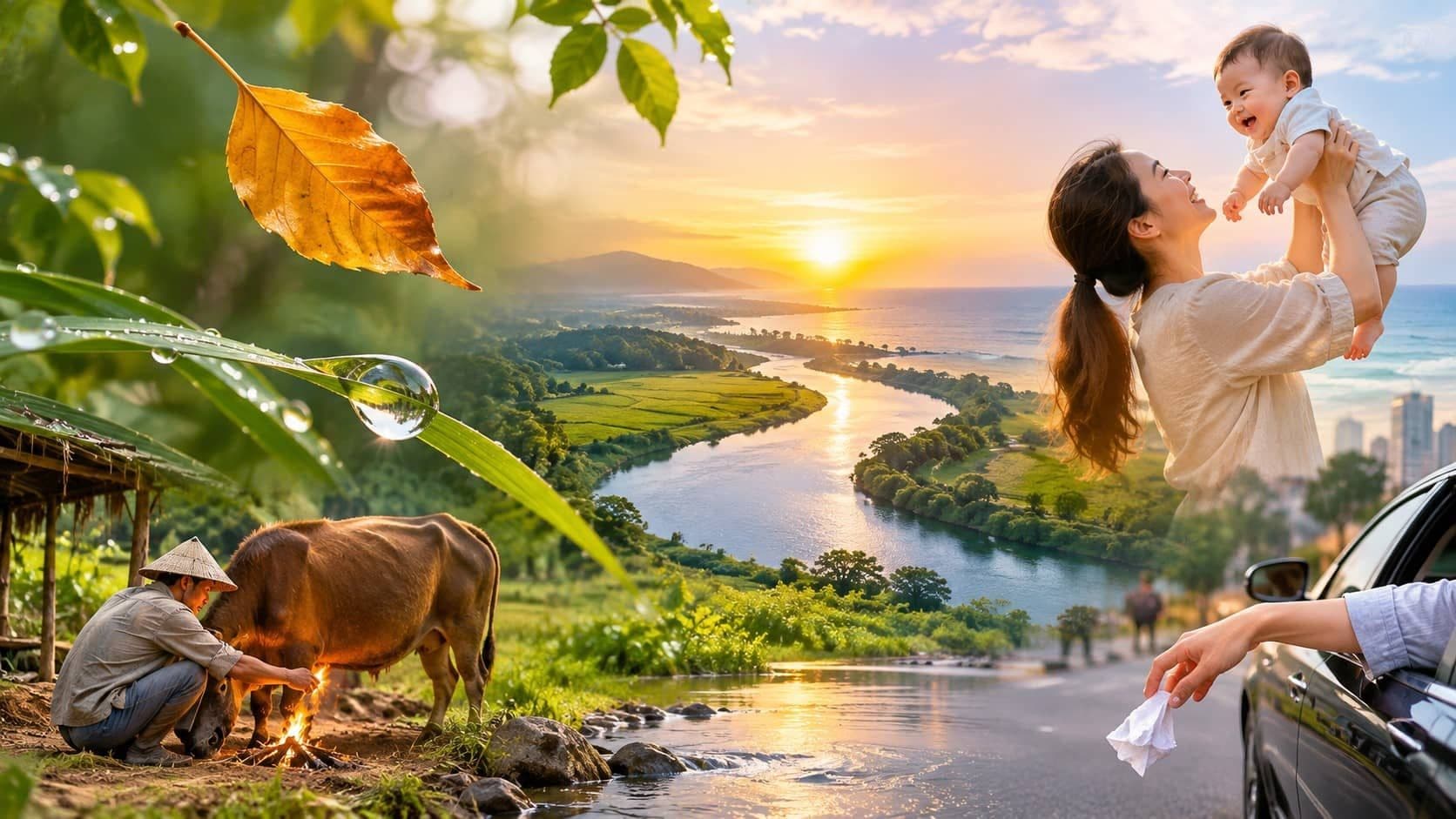
What do you think of when seeing a leaf fall?
In the poem of “Đêm Côn Sơn” (Con Son Night), poet Tran Dang Khoa heard:
Ngoài thềm rơi chiếc lá đa Tiếng rơi rất mỏng như là rơi nghiêng.
They can be translated into English as follows:
A banyan leaf fell
The sound was faint as if the leaf was leaning.
Buddhists see the impermanence of the body. Our body is today strong and good, but it will become weak, round-shouldered and have white hair, wrinkles, tooth loss, etc. and then die. Everything in this life works this way. Our start is nice, but our end is terrible.
What do you think of when seeing a mother hold a baby?
Besides the understanding that the baby will grow up, work hard, grow old and then die as usually, we also see at least these two things:
The first is maternal love. The baby is the mother love’s product and carries her blood, so his love for him is intense and sacred. Many mothers love their children more than themselves. This kind of love is an instinct of man.
The second is the appearance of the baby brings hopes to everyone. We don’t know how the baby will become: obedient or spoiled, filial or unruly, talented or useless, ect., so everyone hopes it will become a useful person. But not all children can fulfill others’ wishes. Some become unruly, some become failures and have to depend on their parents in all their lives. It’s because babies also carry their previous karma which contributes significantly to its future.
Everything in life gives us a lesson to reflect on. But if we don’t have wisdom or understand the Dharma, we can’t draw any lesson and will let life control us. To understand and draw lessons from every small thing in life, we must let our soul be filled with the Dharma and practice the Dharma diligently. When we have wisdom, we will find that everything is the Dharma, but be careful because everything in life can suggest a lesson, but we will be wrong if we reason it because it will lead to a chaotic mind. When our mind becomes calm and pure in meditation and in the reflection of selflessness then naturally every lesson appears. We must practice meditation diligently and see the Dharma in every little thing.
What do you think of when seeing dewdrops?
Dewdrops will disappear when the sun shines, and human life is such fragility and impermanence.
Understanding it, we should stay calm when happy or unhappy and try to find something noble.
What do you think of when seeing rivers flow into the sea?
That is:
Omit all private things, contribute to common ones
Together we will build a good world.
Looking at rivers flow into the sea, we see something in common in the sea. Each stream seems to forget itself to join the big sea, contributing to the immensity of the sea. And for a community, a country, this world, or the universe, each of us is just a tiny individual. So, don’t try to keep something for you, but contribute to common things. If our mind reaches the Awareness state, moral teachings will naturally appear without our reasoning. Then looking at smoke rising into the sky, clouds drifting, what do you think?
What do you think of when hearing the lonely sound of birds at night?
Those who live in forested mountainous areas are used to the sound of birds, bitterns, and owls hunting at night. When the night falls, all sentient beings should return home, so we feel sorry for those that must strive for their food at this time. It’s because everyone has his own karma. We wish everyone to try to create his own blessing to take refuge in. We wish all species to surpass their triviality to become exceedingly blessed people who will try to practice the Dharma for enlightenment.
In this world, there is nothing in which we can take refuge. Our parents will pass away someday, our money can be lost and our houses be sold. The people who promise to love us will betray us eventually. It’s our blessing that we can rely on. Our blessing controls our life. Therefore, everyone must strive to create blessings and don’t be silly just to enjoy pleasures. Be worried when receiving gifts, respect, support, etc. from others because all of them decrease our blessing, and be happy when we use our talents and strength to serve the community.
There is a pagoda which becomes very crowded on occasion of Buddha’s birthday, Vu Lan ceremony, or Bodhi Day, etc. Because of thousands of attendees, there must be a robust logistic support team. This team includes very wealthy Buddhists who have many servants at home but become servers at the pagoda. They’re very active in social work such as helping the needy, clean the beach, clear the streets in the sunshine, or quietly fill every pothole in the night, etc. They are called “miserable wealthy men” because they become servers at pagodas.
The Dharma gives them peace and the way to eradicate their egos. It also gives them the love for people, the ideas of sacrifice and serving others but not cling to their work, and their happiness will spread everywhere. They both practice Buddhism and bring the love and responsibility of Buddhists to life. These things create a real, living Buddhism beneficial to society. And the blessing of such people is significant and will bring them joy and lasting refuge.
Many couples desire to have children. At first, their children are the product and joy of their love. However, the more they grow, the more the parents struggle for life. All parents hope that their children will care for them when being old. Because of their love and this hope, parents accept to endure hardship to raise their children. However, in reality, it’s not rare that parents with many children suffer their loneliness in old age.
There is a story of a mother with five children in Hue, Vietnam. The children deceived their mother into handing over all her savings and properties. They even took the very last penny from her. She then became a beggar. Her five children refused to raise her though they had jobs. She gave her all things to them, but they mistreated her. She had to endure poverty and loneliness at an old age. Maybe she owed something to these five people, or in the past, she grievously sinned and then had to bear such disastrous retribution. Through this story, we know that humans are bad. So, don’t be foolish to rely on them. Only our blessing can be our refuge, hence if you’re not blessed, you don’t have a refuge.
Many childless parents worry for their future, but the truth is their children are not their refuge. Try to create more and more blessing and it will be our true shelter.
We used to live in a cemetery. Near the cemetery lived a lonely old man. He didn’t have any children or relatives. We took care of him, but he was so strict that it was not easy for us to do. Every morning, he came to a nearby hotel to pick up flowers and dried them up at home for money. In our free time, we picked up flowers with him so that he could return home earlier. His house had no electricity, and we helped him to have. When he got sick, we cooked porridge for him and often noticed if he needed anything. Then in a lunar new year, he was seriously ill and died after a few days. We took care of his cremation and took the urn of his ashes to a pagoda.
Earlier before, he told us how he creates his blessing. On Tet holiday (Lunar new year day), he often went to hospitals to give gifts and took care of the patients who couldn’t go home and didn’t have relatives. He did it for many years, and you see how the law of Cause and Effect works. He got seriously ill at the time of Tet, and we took care of him. He bore the karma of loneliness but tried to earn blessing by taking care of patients at Tet’s time, and the blessing made him be taken care of in the last days of his life. It was his blessing that was his refuge.
Our blessing is our refuge but not our children or relatives. Monks and nuns don’t have children, but they always create their own blessing, so when they grow old, the pagoda is their refuge.
Only hearing the sound of a bittern at night, we can understand many things in life. We see the massive difference among sentient beings’ blessing and our blessing is our true refuge in life.
What do you think of when watching a farmer take good care of his animals?
In the North of Vietnam, when the winter comes, you will easily find the scene that farmers make a fire to warm up their cows/buffalos because they fear their animals' death caused by the coldness. What do you think?
Does the farmer really love his cow when making a fire to warm it up? Actually, he loves himself, not the cow. The cow is of great value to the farmer. If it were dead, the farmer would have a little amount of money, so he has to keep it alive so that it will help him do the farming work and produce many calves which also helps him earn money. Looking at the action, we think the farmer has a great love for the cow, but when its meat brings him a lot of money, he'll be willing to let it be slaughtered. That's humans.
People treat others the same way. If someone tells you that he loves you and will take good care of you, don't jump to the conclusion that he really loves you. People often change, and their love will fade away soon. Therefore, maybe he treats you the way the farmer treats his cow. He may harm and betray you at any time. And you can find so many such cases. We love everyone but don't trust all of them. If someone loves you, respect and feel grateful to him, but don't rely on or feel proud of his love.
It reminds us of the story of King Pasenadi and Queen Mallika at the Buddha’s time. The queen came from the working class but very wise and profound. She treated people tactfully and handled things wisely, so the king respected and loved her much.
Once, King Pasenadi and Queen Mallika had a conversation. The king honestly said:
- I am the king and have many queens, and among all of them, you are the one I love most. How about you?
- You are the one I love most in life!
Being wise and not wanting to upset the king, Queen Mallika didn’t dare to say anything different. And when the king was delighted, she added:
- But, if you don’t get angry, I’d like to correct my words.
- Go ahead.
- Actually, I love myself the most.
- How can it be? How can a person love himself most?
- The fact that you love someone is because that person brings you happiness. You bring me fame, wealth, and happiness, so I love you. If you’re a beggar, how can I love you?
The king thought it was reasonable but ruthless, so he brought the story to Buddha, and Buddha confirmed the correctness of Queen Mallika’s words. The truth is people only love themselves. So, when seeing a farmer warm up his cow, we know that true love doesn’t exist. People only love ones who bring them benefit and happiness.
Princess Thien Thuy (Tran Quynh Tran) is the sister of King Tran Nhan Tong. She had an excellent credit for expanding farming land, building farms, planting crops, and gathering people to work on these lands. Later, she became a famous nun named Thien Duc. When she got seriously ill and was near her death, King Tran Nhan Tong (named Truc Lam at that time, and was practicing Buddhism on Mount Yen Tu) came to visit her. The king composed a poem:
Thế số nhất tức mặc
Nhân tình lưỡng hải ngân
Ma cung hỗn quản thậm
Phật quốc bất thắng xuân.
They can be translated as follows:
One’s life is in his breath, hence it will end when there’s no breath.
People’s love is fragile and unfaithful.
The palace of ghosts is noisy.
Buddha world is Spring world.
So the realm of Buddha is the realm of Spring because when you go to a pagoda, you will meet compassionate Buddha, the source of ethics for people to love each other, genuine monks/nuns, and everyone feels happy, we know we’re in the realm of Spring. And if it is spring, but people hate each other, then it’s not spring realm which only exists in people’s heart and in the realm of Buddha. The Buddha realm contains the whole of the spring realm because, in the Buddha realm, one loves one another unconditionally and selflessly. So, when in a pagoda, our mind is calm, and we are ethical and love others, we are living in the Spring realm. So if you see a farmer taking care of his cow, he really loves himself rather than the cow. And this is also the way people treat others.
Understanding it, we should love the Dharma more and more because Buddha teaches us to have unconditional love for sentient beings. When loving someone, we wish we would love him forever, and he will love others. We only wish him to repay our love by using his talents and morals to benefit life and to love others rather than us.
Once, A Master had a retreat in a hut in a deserted area. It was the dry season, and his well was depleted. Digging a well needs two people: one digs, and one on the ground lifts the soil. The Master was wondering what to do because he was alone. Suddenly, there were two good-looking boys aged 17, 18 came to the field. The Master called him and said:
-
My well is dried up in this dry season. I would like to have you dig it a little deeper for water. Then the two brothers did it for a day. The Mastered then knew that these two boys were obedient and did well at school, and because of poverty, they had to leave their hometown in the Central of Vietnam for the South to make a living. The Master then gave them all the money he had at that time. He said:
-
Here’s your money.
-
You give us too much. It’s much more than our labor in a day.
-
Never mind. I know your family is in difficulty. Let consider it my love for you. When becoming successful, let help others, and that’s the way you remember me.
The two brothers were touched and took the money happily. They then promised the Master to do what he taught.
You see, looking at a farmer making a fire to warm up his cow, we have many thoughts.
What do you think of when seeing a beautiful hand throwing garbage on the street through a luxurious car’s window?
It’s not rare to catch a beautiful hand throwing garbage on the street through a luxurious car’s window. The window then rolls up, and the thrower continues with his/her travel. He/she doesn’t care who will pick up the garbage or if it makes the view ugly. What do we think?
What do you think of when seeing a beauty queen?
Usually, men find her attractive, and women don’t think so.
But with the understanding of Buddhism, we see at least three things:
The first is her blessing: She must have done something good in a past life, and hence is beautiful in the current life and became the winner of a beauty contest.
The second is that now she is a beauty but her beauty will fade when she gets older, and as ordinary people, she will have wrinkles, poor eyesight, tooth loss, and a crooked back. No matter how beautiful she is, she can’t avoid the law of impermanence.
The third is that beauty is only skin-deep. People are first impressed by someone’s appearance, but when living with this person long, you will realize his nature, and that’s why beauty contests often include questions to judge candidates. And from now on, when we see a beauty, don’t hurry to praise or criticize her but wait and see her soul.
Everything in life gives us a lesson, and when our soul is filled with the Dharma, we will see everything in accordance with the Dharma. But if we have a hard heart and don’t learn the Dharma or practice meditation, we see nothing or have only wrong/bad thoughts.
Written by:
Janna
Related Articles:
What Do You See? – Discovering the Dharma in Everyday Life
Quiet but Eloquent: Sincerity, Wisdom and the Balance of Mind
Compassion and Strictness in Buddhism: Be Calm but Diligent
As Meek as Grass, as Small as a Fig, as Heroic as a Mighty Warrior
We Receive Favors Every Day – The Importance of Gratitude
Instruction on Meditation: Essential Methods and Practice Guide
The Basic Meditation Technique: 5 Essential Steps to Practice Meditation
Meditation, Business Intuition and Wisdom Without Greed
Meditation Q&A 86–90: Hindrances, Instincts and the Four Jhanas