
Janna · Nov 16, 2026
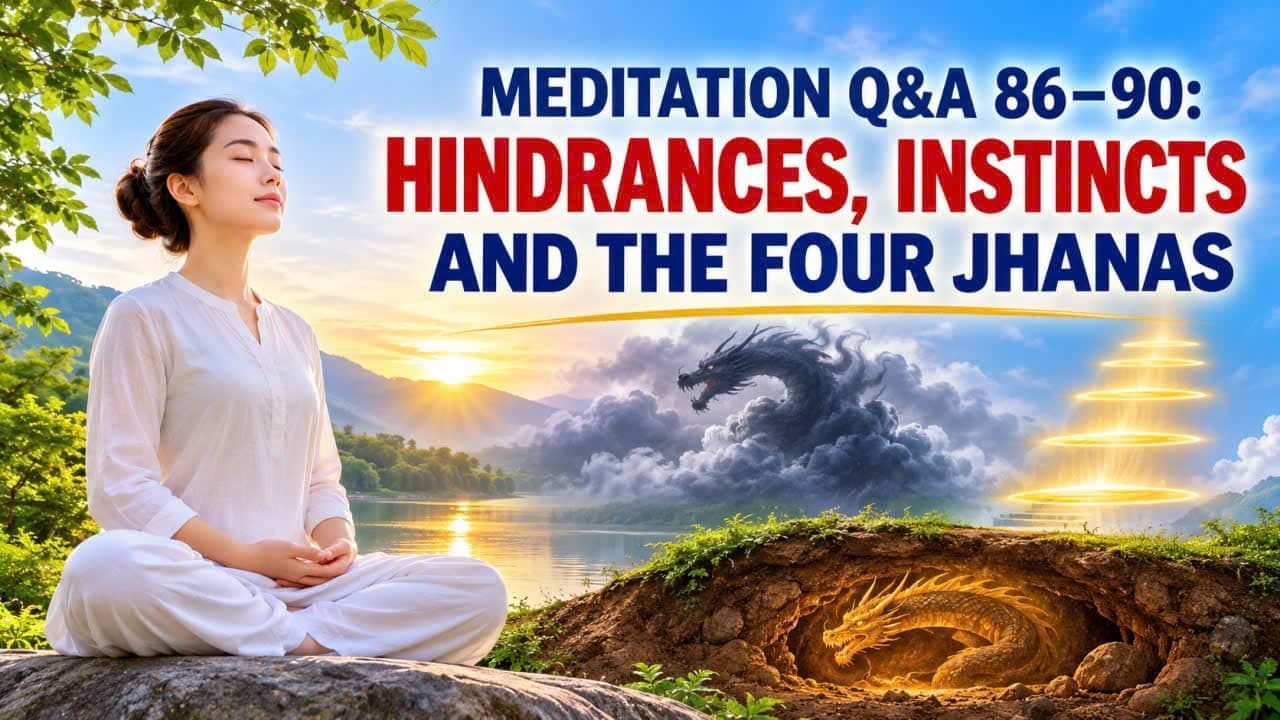
MEDITATION Q&A 86–90: HINDRANCES, INSTINCTS AND THE FOUR JHANAS
QUESTION 86: HOW DO HINDRANCES (NĪVARAṆA) AND INSTINCTS DIFFER?
ANSWER: The word “saṃyojana” (instinct) means the shackles that bind the mind, causing the body and speech to act in unwholesome ways. In short: instincts are unwholesome tendencies, unethical actions, and instinctual drives that lie deep within the mind. The ten instincts, from gross to subtle, as affirmed by the Buddha, include: self-view, doubt, clinging to rites and rituals, sensual desire, ill-will, attachment to form, attachment to the formless, conceit, restlessness, and ignorance. These ten instincts are mentioned by the Buddha in the "Snake Simile" discourse found in the original Nikāya scriptures.
The stages of Sainthood in Buddhism, from lowest to highest, are assessed according to the degree to which these instincts are eradicated. The eradication of the instincts is precisely the progression of moral development. Therefore, a Saint must be a person of overflowing, complete, and steadfast morality, and their inner mind must also be very pure. A practitioner, no matter how vast their knowledge or how deep their meditative absorption, if their morality is not steadfast, and the instincts have not been eradicated, may not have attained Sainthood.
Hindrances are like dragons in the clouds (Cloud dragon), sustained by discursive thoughts. If the clouds dissipate, the dragon falls because it has nothing to cling to. Instincts, on the other hand, are like dragons in the earth (Earth dragon), very firm and never completely lost, like one's basic instincts. For example, the greed of the hindrances and the greed of the instincts are different. Those who attain meditative states eliminate the greed of the hindrances and no longer display greed; they are purified. But the greed from the instincts is not yet eliminated. Those who attain meditative states, even deeply absorbed in samadhi but who have not yet subdued the instincts - those "earth dragons" lying deep in the earth - are extremely resilient. For many years, only the Buddha taught this, it is extremely profound and subtle.
QUESTION 87: WHEN THE MIND IS TRANQUIL, NUMEROUS WONDROUS REALMS APPEAR. IF WE RELEASE THE BREATH THAT IS CONNECTED TO THE MIND, WHAT HAPPENS?
ANSWER: When we focus on the breath with the appropriate breath volume, and it becomes connected to the mind, we are entering a state of meditative absorption to get into the ‘meditation castle’. As our mind begins to settle, countless wondrous things appear: realms of emptiness, purity, clarity, bliss, and joy. We can easily become distracted, no longer paying attention to the breath but instead turning towards those wondrous realms. Even if we no longer pay attention to worldly illusions, if we direct our attention to these meditative realms, we are ‘betraying’ the breath that is connected to the mind.
Many people make this mistake. When they focus on the wondrous states of emptiness, clarity, and joy in the mind, they think they have attained enlightenment. The conceit begins to arise, feeling complacent with those states, thinking oneself superior to others. But in reality, at that moment, we are exiting the state of concentration, turning our backs on the correct path, and leaving the palace gate without realizing it.
QUESTION 88: HOW ARE TRANQUIL MIND AND PEACEFUL MIND DIFFERENT?
ANSWER: A tranquil mind is a state where the mind has few or no wandering thoughts. Meanwhile, a peaceful mind is knowing that one is not at fault. Peaceful mind does not hold a particular spiritual value, but it shows a high moral value.
In a Russian movie about the relationship between an intelligence officer and his journalist friend, who was bribed by reactionary forces. Satisfied with his luxurious life, the journalist sarcastically asked his friend: "You dedicate your whole life to protecting the country, yet you remain poor. Is it worth it?" The officer simply replied: "But I have peace of mind!" This answer clearly shows that peace of mind is knowing that one is not doing anything wrong. The moral value of this peace of mind surpasses all worldly material gains.
Similarly, when we contemplate and see the ultimate truth that our mind still has ignorance and defilements, is our mind truly tranquil? Perhaps not yet. This is because ignorance is still there, wandering thoughts and defilements are still there. Ignorance is the final instinct that only an Arahant can overcome. Until one achieves Arahantship, ignorance is certain to remain. Recognizing this truth brings peace of mind.
So, when we sit in meditation, we may attain a tranquil mind (at varying degrees), but we may not necessarily have a peaceful mind. A tranquil mind means discursive thoughts have subsided, but if we do not see that "within that tranquil mind, there is still ignorance and defilement," then we cannot truly have "peace of mind" because there is still a possibility of being wrong. But when, whether the mind is still or tranquil, we know that we still have ignorance and defilements, then we have peace of mind that the path is correct, because we see the ultimate truth. And when the breath touches the mind, and we can settle the breath with the right volume, we "grasp" the mind. At that moment, we have arrived at the palace gate, not yet having entered meditative absorption, but we have a feeling of peace of mind about the path we have chosen.
QUESTION 89: WHAT IS RIGHT MEDITATIVE ECSTASY?
ANSWER: Right Meditative Ecstasy is the highest aspect of the Noble Eightfold Path, equivalent to the Cessation of Suffering. Right Meditative Ecstasy is the stage where practitioners no longer need to make a conscious effort to focus the mind; the mind naturally abides in purity, with four levels ranging from the First to the Fourth Jhāna. Thus, we must understand that while the mind is pure, it has varying depths and shallowness; not all serene minds are the same. In normal daily life, a practitioner possesses the Right Mindfulness, and only when necessary do they sit still to enter these levels of Meditation.
A practitioner must go through a very long period of Right Mindfulness, sometimes even 30 lifetimes, eradicating the Five Hindrances before they can enter Right Meditative Ecstasy. By eradicating the Five Hindrances, the practitioner is no longer greedy, angry, or troubled by the ups and downs, successes and failures, or honors and disgraces of life. Achieving that self-mastery, the ancients called it "unmoved by the Eight Winds," but even then, compared to the progress of meditation, one has still not entered the First Jhāna. Thus, the levels of Jhāna according to Buddha standards are extremely profound and sublime, and anyone who perceives them and develops admiration for them sows good seeds in their mind for their spiritual practice. On the other hand, anyone who misunderstands or deliberately diminishes the value of the Levels of Jhāna will incur heavy demerit.
QUESTION 90: WHAT IS THE STATE OF THE FIRST STAGE OF MEDITATION?
ANSWER: The First Jhāna is the first level of meditative absorption. In Chinese, "Sơ" (pronounced shū in Mandarin) means initial or first, not rudimentary or sketchy as it might imply in Vietnamese. The characteristics of the First Jhāna are detachment from sensual desire, enters and abides in the first Jhāna, which is accompanied by the sense of pure happiness (i.e. rapture and pure joy) (because of the elimination of sensual desires), the deep and subtle thoughts (vitakka31 and vicāra32).
Sensual desire has two meanings: one is worldly craving, and the other is sexual desire. One who has attained the First Jhāna has ceased both kinds of craving; this is called "detachment from sensual desire." "Detachment from unwholesome states" means that the inner mind is purely wholesome, never thinking wrong thoughts, never having the intention to harm any sentient being, only having loving-kindness and compassion. Such a person knows what is right and wrong, correct and incorrect, wholesome and unwholesome in every small detail, so they are also very discerning when perceiving and judging external matters.
Rapture means joy, and Pleasure means happiness. "Rapture and pleasure born of detachment" means that when all worldly desires cease, the body and mind are filled with joy, which is so great that the practitioner no longer craves anything else.
The happiness of someone who has attained the First Jhāna is described by the Buddha as the feeling of the whole body being like a mass of soft, smooth, cool dough from the inside out, without overflowing even a drop, not sagging, and very firm. The mind of someone who has attained the First Jhāna is firm yet soft and supple, as if thoroughly permeated from the inside out, with no small part that is not happy.
Different from the stage of Right Mindfulness, where one still has to skillfully maintain and apply effort, even though the mind seems quite tranquil, the practitioner who has entered the First Jhāna has entered a state of purity, the mind is free of discursive thoughts, and it automatically abides in concentration. But only the Buddha knows that deep in this person's mind there are still very subtle notions of profound Dharma (deep thoughts and subtle thoughts) that still arise gently and automatically.
If it weren't for the Buddha's warning, all practitioners who reached this point would stop, thinking they had achieved the ultimate. These hidden notions about one's practice and accomplishment create a kind of understanding of the Dharma and a secret sense of pride. The practitioner will easily answer esoteric Zen phrases or enthusiastically give Dharma talks if given the opportunity... Because these wrong views and conceit can arise, one can still regress. Therefore, the practitioner should never forget the contemplation: "Deep inside, there is still ignorance and defilement."
Written by:
Janna
Related Articles:
Meditation Q&A 81–85: Five Hindrances, Right Mindfulness and Stream-Entry
Meditation Q&A 76–80: Karma, Mind Concentration and the Five Hindrances
Meditation Q&A 71–75: Dopamine, Meditative Bliss, True Mind and Buddha-Nature
Meditation Q&A 66–70: The Hidden Secrets of Breath Meditation and Mindfulness
Meditation Q&A 61–65: Overcoming Drowsiness and the Six Steps of Mindfulness
Meditation, Business Intuition and Wisdom Without Greed
Instruction on Meditation: Essential Methods and Practice Guide
The Basic Meditation Technique: 5 Essential Steps to Practice Meditation