
The accumulated sufferings of sentient beings in their samsara are
much more than the water of the sea. When we were Buddhist beginners, we thought that this statement was an exaggeration because we thought how could people's tears be compared with the sea in size? But when we have a better understanding of Buddhism, we know that what Saints say is precise. The total amount of tear of all people in this world through their countless lifetimes is much more than the water of the sea. Tear symbolizes the suffering of sentient beings and it cannot be measured.
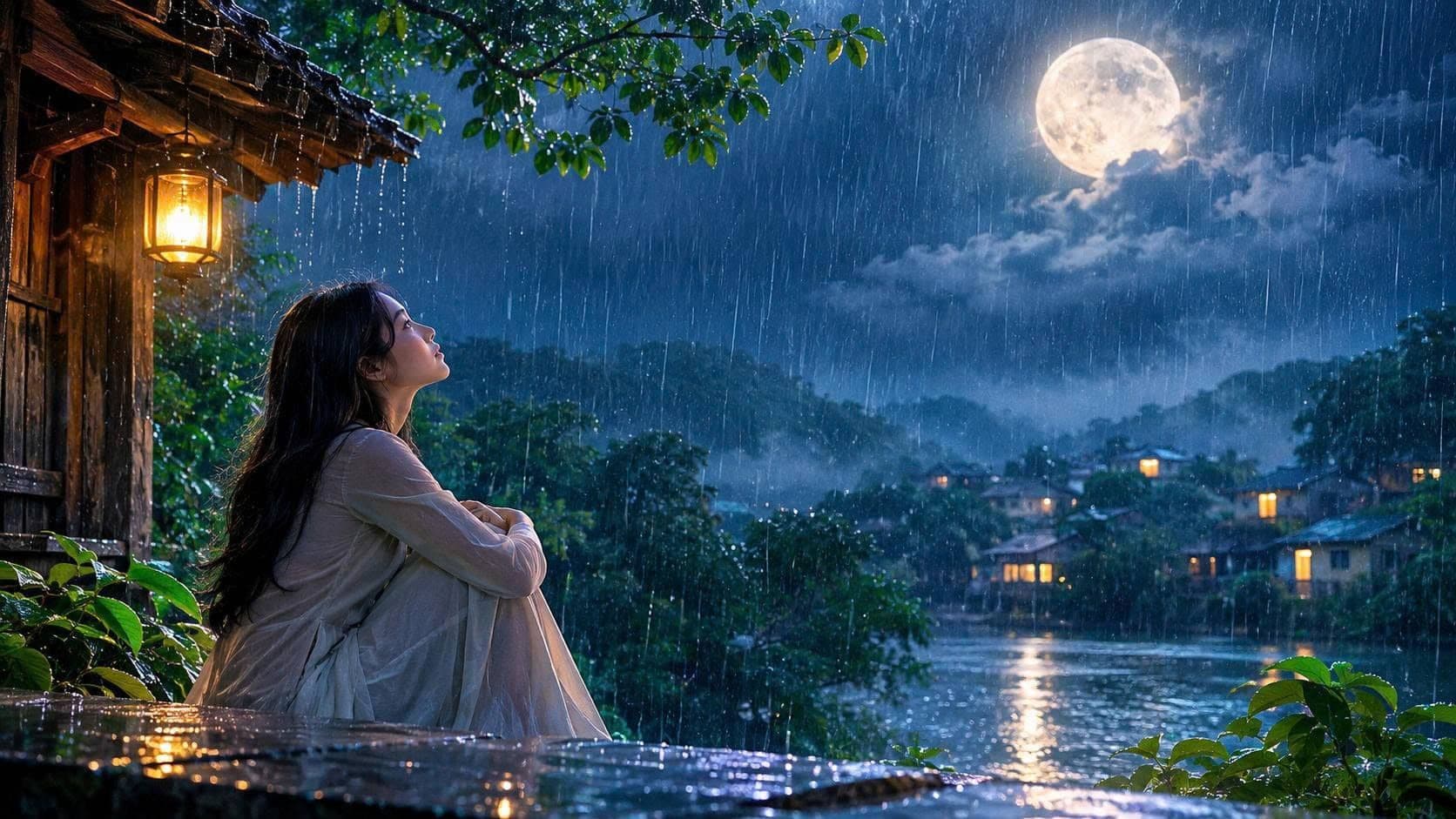
WHAT DO YOY SEE...
We’ve seen many things in life: the moon rising, the rain falling, waves at the see, people in misery, etc., but everyone has diffrent opinions about them. Thse who understand the Dharma see the Dharma in everything they see, and who don’t, have wrong thoughts and so are attached to life forever.
THE NATURE OF OUR SOUL IS EXPRESSED THROUGH OUR THOUGHTS
On a cold rainy night, what do we see after the rain?
Musician Duc Huy wrote “Tiếng Mưa Đêm” (Rainy Night) to express how much a man misses his girlfriend.
Mưa rơi mưa rơi
Còn rơi mãi nhớ thương ai
Ướt bờ mi em dài
Mưa rơi mưa rơi
Còn làm mưa mãi trong đời
Người đã xa vắng rồi...
They can be translated into English as follows:
Looking at the rain I miss my girl I wonder if her eyelashes get wet. Rain keeps falling Forever in my life And she was far away.
But for little poet Tran Dang Khoa, everything becomes very cute and lovely after the rain: Termites fly everywhere, Mr. Sun dresses a black armor to go into a battle, thousands of sugar canes play with swords, ants march on the road, and trees:
Cỏ gà rung tai
Nghe
Bụi tre
Tần ngần
Gỡ tóc...
They can be translated into English as follows:
Grass vibrates
Listen to
Bamboos
Hesitant to
Comb the hair
The world of things is very lively as if everything in it has a soul.
In another case, the rain made the poet miss his beloved teacher:
Nghe trăng thở động tàu dừa
Rào rào nghe chuyển cơn mưa giữa trời
Đêm nay thầy ở đâu rồi?
Nhớ thầy, em lại lặng ngồi em nghe...
They can be translated into English as follows:
Listen to the moon breathing
Then the rain pouring
Where are you tonight?
Missing you, I sat quietly.
Also on a rainy night, we wrote the below song:
Tonight the rain falls all over places
Is it the rain or the sound of people's joy that filled my dream.
This place is warm
I love ones who
Wander everywhere
And dream of a house
On a rainy night
Water's flowing through the corner of the yard
Some are lonely on the deserted street.
This is the song named “Tiếng mưa đêm” (Rainy night). Homeless people are very miserable on cold rainy nights. Those who are luckier has a shelter, but many are unlucky. It tormented us and made us write a song about the wish for people to love and help each other in this impermanent life so that none would be lonely and unhappy on rainy nights.
Life is a cold rainy night
Don't let our loneliness wipe us away
We can't help much
But will share every worry with others.
On a rainy night, the musician remembered his ex-girlfriend and his memories and expressed them through the song. How about us? What do we think on a rainy night, and what do we wish, for us or for others?
With the same scene, everyone has his own ideas. And everything in this life works this way, and it's because everyone has his own soul. The outside world is just a means to reflect our soul though thinking, lifestyle, and behavior.
“Em nhìn thấy gì” (What do you see) is also the name of one of our songs:
What do you see at sunrise
When the sun's early rays reach every eye.
The song conveys our reminder to everyone: everything can give us a great lesson. If we understand the Dharma, we can think about noble and right things; but if we don't, we only have nonsense thoughts or cannot understand anything.
Once, Buddha used his supernatural powers to bring a very young Arahant to the top of a mountain. He was the novice Tissa, who attained Arahantship at the age of seven. His dignity was extraordinary. Through the divine eye of a Buddha and an Arahant, despite standing in India, They could see through the immense waters beyond the Indian Ocean. Buddha asked the novice, "What do you see in the vast sea?"
Venerable Tissa replied, “Venerable Bhagavat, I see the vast sea, and I understand that the tears of sentient beings are much more than the water of the sea.”
“My dear, let's go up the mountain
life. What do you think of the ocean?”
Venerable Bhagavat, The Supreme Father
ching I have seen in the cycle of birth and death
Tear of sentient beings
Much more than the vast sea
Much more than thousands of rivers
Their suffering is endless.
That is, the accumulated sufferings of sentient beings in their samsara are much more than the water of the sea. When we were Buddhist beginners, we thought that this statement was an exaggeration because we thought how could people's tears be compared with the sea in size? But when we have a better understanding of Buddhism, we know that what Saints say is precise. The total amount of tear of all people in this world through their countless lifetimes is much more than the water of the sea. Tear symbolizes the suffering of sentient beings and it cannot be measured.
Looking at the immense earth, the Buddha asked: "Seeing the vast land, what do you think, my dear?"
He replied, "Venerable Bhagavat! I know that under the immense ground there is no place that doesn't have the bodies of sentient beings."
My dear, let's look at all directions
What do you think of this immense world?
Venerable Bhagavat, The Supreme Enlightened One
I see dust, sand, and soil
I see on every hill and mountain
Everywhere sentient beings' bodies can be found.
Because of their ignorance, they are kept in samsara
Who knows how many times he has died.
Throughout countless lifetimes, every inch of the earth has the bodies of sentient beings buried beneath. This statement is not exaggerated. However, if venerabe Tissa didn't say it, we can't know it. Looking everywhere and we only find the blue sky, huge mountains, meadows, vast forests. However, with the eye of an Arahant, venerable Tissa sees every inch of earth contains sentient beings' bodies. They were born, grow old and then die, are forever attached in samsara. But in the endless samsara, few are aware of their suffering and desire for the way to enlightenment and liberation, and most look for pleasures in this fragile life. They feel happy when having money of others and upset when losing their money. Only few can remain calm and peaceful in the face of adversity because they understand it's how life works.
A wife was very painful to discover her husband's love affair. She was so miserable that a Master had to advise her. He said, "Such things are very popular in this world. We must be wise to remain our peace and calmness and go through it but not suffer."
At this time we feel happy, and at another time unhappy. Happiness and unhappiness alternate and unhappy. Happiness and unhappiness will remain his peace both make us uneasy. A wise man will remain his peace and calmness while going through adversity. He doesn't feel happy when having happiness, and so doesn't feel unhappy when having unhappiness. And we also know that samsara is the endless cycle of birth and death, so our true purpose is not the joy in this life but the true enlightenment.
There are so many things in this life worth our contemplation but we don’t contemplate, and our morality doesn’t grow. Venerable Tissa found the Dharma in everything in this life, but we don’t. The song “Em nhìn thấy gì” (What do you see) is our reflection of life as well as the teaching of Venerable Tissa through a conversation with Buddha: Everything in this life contains the Dharma, and the point is if we can understand it.
A meditation master once said:
All things are the Dharma
But I didn’t understand it and was attached to my samsara of ignorance.
Everything can give us a lesson, but because we don’t understand, we are kept in the course of life.
Written by:
Janna
Related Articles:
Quiet but Eloquent: Sincerity, Wisdom and the Balance of Mind
Compassion and Strictness in Buddhism: Be Calm but Diligent
As Meek as Grass, as Small as a Fig, as Heroic as a Mighty Warrior
We Receive Favors Every Day – The Importance of Gratitude
Debts Are a Burden to Our Soul – The Wisdom of Living Without Debt
Instruction on Meditation: Essential Methods and Practice Guide
The Basic Meditation Technique: 5 Essential Steps to Practice Meditation
Meditation, Business Intuition and Wisdom Without Greed
Meditation Q&A 81–85: Five Hindrances, Right Mindfulness and Stream-Entry