
If in the past, someone gave you 2000VND,
and then in your next life if you see them again, you will have to give him 200,000VND, two hundred times more than the original amount. Why is the interest so high, you may ask - It's because the interest rate of samsara is much worse than the one of criminals. In a past life, we owed 1 then in our next life, we have to pay back 100. However, if we repay morals to the lender then 100VND does not even matter.
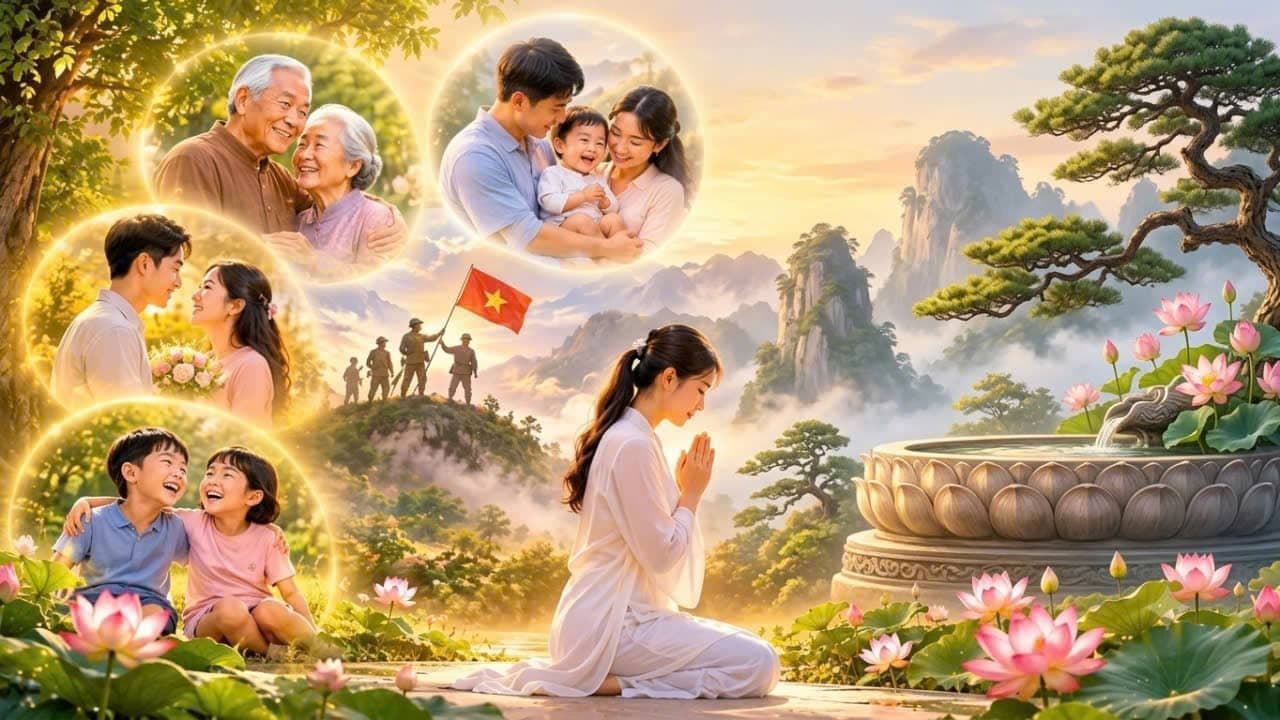
OUR DEBTS IN LIFE
Every relationship in this life only bases on borrowing and paying
From society's perspective, we can divide the sentiment of humans into many kinds. For example, one kind of sentiment is between parents and children, and another kind of sentiment is between husbands and wives, as well as the kind among siblings, and yet another is the kind between us and our enemies... That is, we divide our sentiment – we should love someone or we should hate them – so that we will have the right attitude in accordance with morality and the law.
The relationship between parents and children is also this way. There was an infertile couple who begged gods and sought out various treatments because they wished to have a baby. And, when their baby came into this world, they were very happy and loved the baby immensely. Although the baby was very young, he didn't show any respect for his parents, but his parents showed their respect for him. It sounds incredibly strange but is definitely true. That is because the parents owed the baby. Conversely, there are also cases where children love and take great care of their parents. This is because these children owed their parents, so naturally, they have love and filial piety for their parents. So, based on the way someone treats others, we can know who owes whom. And this is the way of ordinary people, how about Buddhists?
As Buddhists, first of all, we owe a big favor to Buddha Who shows us the holy path to go on, to Patriarchs who dedicated their life to preserving Buddhism, and to venerable monks who spend their life truly practicing Buddhism. Thanks to these monks' great example of virtue, we have faith in Buddhism and know that Buddhism is the right path that we should persevere in following until we reach its destination.
And because we are citizens of the heroic country Vietnam, we owe a favor to King Hung's and our forefathers who worked hard to preserve and develop our country. We owe a favor to the good officials who wholeheartedly care for the people, and to the soldiers who are day and night in dangerous places guaranteeing our country's peace. The amount of work the state leaders do is so much compared to the salary they receive, that's why the people owe a great debt to genuine leaders.
Preachers owe a favor to the listeners because without them, the preachers cannot preach. Since Buddhists are devout and have so much love for the Dharma, they do not care how long their journey will be, or how difficult it will be to go to temples to listen to sermons. Thanks to the attention and happiness of the listeners, the preachers feel energetic to preach, hence, their lecture will be more interesting. The lecture will also be recorded for many other people and it will bring great benefit to them. Thus, if you listen to the lecture intently, you will earn a huge blessing.
In every situation in our life, everything is based on owing and repaying. For example, there are two people who have just met but feel uncomfortable and dislike each other, and they don't understand why. It is because in their previous life, they harmed each other and their hatred has lasted to this life. Because their hatred was not resolved or just partially resolved, so in this life, when they meet they dislike each other.
Our greatest debt in life is sentiment
People must repay what they have borrowed. However, it's not as simple as when they repay a bank loan. Favor debts always go with affection.
Let us consider the case above when the young man was worn out and asked for help from an unacquainted person. This person treated him nicely, provided him with a meal and gave him some money. So, this help included not only material things but also sentiment. A debt consists of two parts: one is about materials and the other is about sentiment, and sentiment makes our debts much greater and is a burden to our mind. Our Buddha once said, “Our greatest debt in life is sentiment.”
When someone beats you and later you beat him back, will everything between you and him be all right? No, it won’t, because when one harms you, he does it with hatred.
That Buddha said, “Love and hate is the cause of suffering” is totally true. Love and hate place a burden on our heart, and more dangerously, it binds us to our samsara forever.
For example, a man and a woman in love decide to get married and think that you will have happiness. However, entering into their married life, they realize that they have a lot of responsibilities not only for their husband’s or wife’s family but also for their children. And when they maybe have not yet completed their career, they have to concern about their children’s future. And when their children have not yet been able to stand on their own feet, they may get married and have babies. As grandparents, they have to care for their grandchildren. So, their life is a life of worries, thoughts, and arrangement, and their responsibilities continue to grow.
This is why many people say that if they had known marriage caused so much suffering, they would not have gotten married, or if they had encountered Buddhism earlier, they would have become a monk. But, why do people keep entering into married life? – Because of their intense romantic love which results from their past karmic debts.
People have to reincarnate forever to repay their debts. Those who can rely on their spiritual cultivation to control their heart, pay back all their debts of materials, and to rid themselves of love and hate, will start to become liberated. Liberation consists of two parts: the first is paying back all our debts of material things, and the second is getting rid ourselves of selfish sentiment.
Similar to the case of when the young man above was extremely tired and asked for help from a person whose house was on his way. He had a debt of material things which is the meal and the money as well as a debt of sentiment which is the host's kindness. The host was very kind to the young man, which made him feel warm; if otherwise, the host coldly gave him a meal and some money, then the story would become much different. The man owes two debts, one is of materials, and the other is of sentiment, and he has to repay both.
Philosophers divided love and hate into many categories such as the behaviors between husbands and wives, behaviors between parents and children, behaviors between the king and the people, loyalty, patriotism, etc. Depending on this division, we can develop proper behaviors toward others. Only when we have proper behaviors (love, hate), can we become a good person and repay our debts.
We must pay off all our debts to be released from our life.
Don't ever think that you don't need to pay off your debts and can become liberated by only practicing spirituality. Those who want to become liberated by becoming a monk have a faster way to pay off their debts. Becoming a monk doesn't mean that you avoid paying back your debts but that you will have a special way of paying off debts many times faster than normal. It sounds strange but it right.
As an example, in a past life, there was a very poor man who had to depend on others to survive. That man, consequently, had a lot of debts. However, one day he found Buddhism and vowed to become a monk. In his next life, he has two causal conditions, one is that he owes many debts to his many benefactors from his previous life, and the other is that he desires to become a monk. The second causal condition makes him leave his home for the religious life.
How he can repay his debts when he lives in a pagoda, you may ask. The truth is that if he didn't become a monk, he would have to repay his debts one by one and maybe for all his life, and in his case, he would never be able to pay off all his debts. But since
he became a monk, his diligent and serious spiritual cultivation is enough to pay off all the worldly debts, but why? The ordained have a unique way of repayment, which is through their teaching morals and spirituality. And morals and spirituality are priceless.
As you know, the venerable monks must have owed favor debts to many people in their previous lives. They owed the country, the king, their parents, their brothers, and their friends, and so on, that's why they have to be reincarnated in this life in order to pay back their debts. However, unlike normal people, they don't search out each of their benefactors to return favors but repay their benefactors through their virtuous and religious life, which is priceless morals.
As an example, if in the past, someone gave you 2000VND, and then in your next life if you see them again, you will have to give him 200,000VND, two hundred times more than the original amount. Why is the interest so high, you may ask - It's because the interest rate of samsara is much worse than the one of criminals. In a past life, we owed 1 then in our next life, we have to pay back 100. However, if we repay morals to the lender then 100VND does not even matter.
It's like in a former life, these Abbots had borrowed 1000VND and in this life, the Abbots repay the debt with gold, pearls, and jewels. These valuables are worth multiple times more than that 1000VND, so the Abbots not only pay off their debts but also make sentient beings become indebted. So the ordained not only pay off their debts very quickly but also do many big favors for life.
Written by:
Janna
Related Articles:
Fear of Debts Is a Virtue – The Karma of Owing and Repaying Debts
The Instinct of All Species: Natural Programming and Rational Thinking
We Do Not Benefit From All of Our Blessings
How to Live Morally and Ethically – Virtue, Compassion and Blessings
Selflessness, Meditation, Wisdom, Compassion and Courage
The Basic Meditation Technique: 5 Essential Steps to Practice Meditation
Instruction on Meditation: Essential Methods and Practice Guide
The World Has Never Had a Standard Science of Meditation
Meditation Q&A 51–55: Impermanence, Body, Sin and Mindfulness