
Janna · Nov 1, 2026
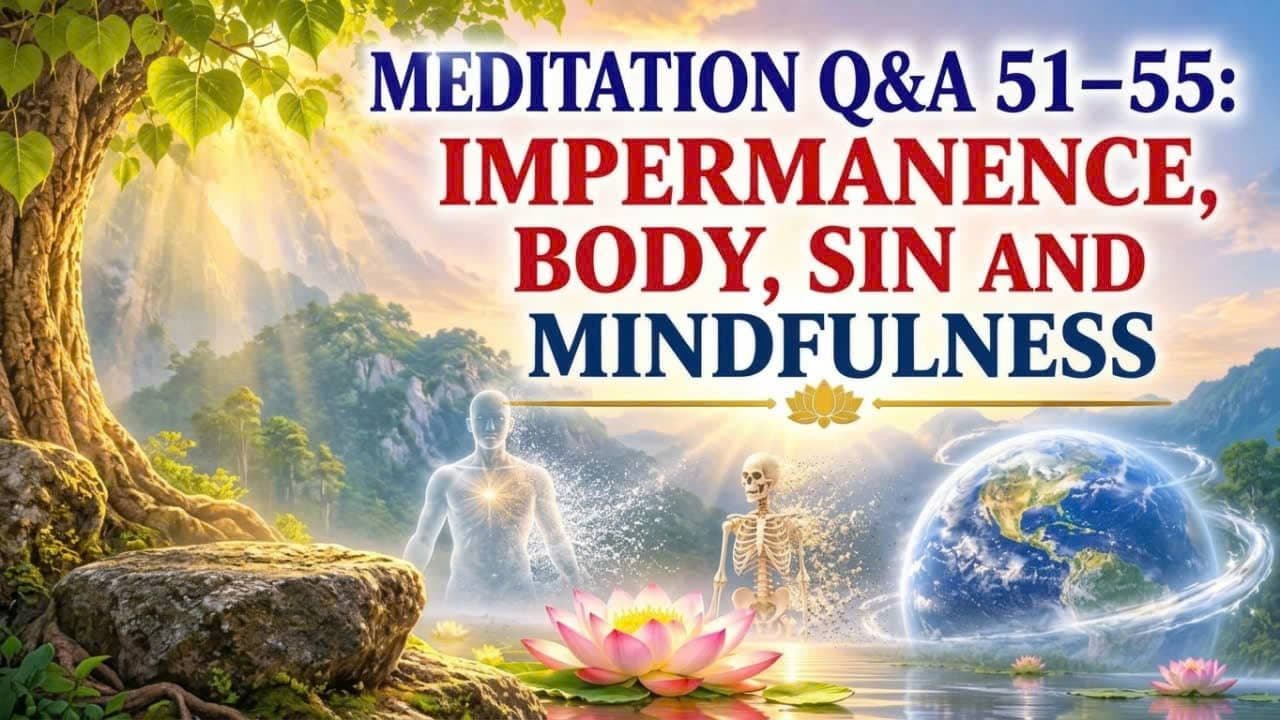
MEDITATION Q&A 51–55: IMPERMANENCE, BODY, SIN AND MINDFULNESS
QUESTION 51: WHY MUST WE THOROUGHLY CONTEMPLATE THE BODY IMPERMANENCE AND FLEETINGNESS, UNTIL THE BONES TURN TO DUST AND SCATTER AWAY?
ANSWER: In Buddhism, the practice of contemplating impermanence ultimately aims to break the attachment to the self and achieve complete non-self. This concept has never been mentioned in any other philosophical system or religion. On the path toward non-self, the first step is meditating on the fleetingness of the body to break the attachment to the body. Attachment to the body arises from seeing one’s physical form as precious—desiring wealth for bodily comfort, pursuing beauty to earn others’ admiration, or striving for money and power to be served by others. From this, the ego continually grows.
When sitting in the full lotus posture, we become fully aware of our entire body and relax it according to the techniques of meditation, enhancing our mindfulness. However, the attachment to the body may resurface. Therefore, we must intentionally make a consideration of the impermanence of the body: “One day, this body will age, fall ill, and die. After death, it will gradually decay, decompose, and eventually even the bones will turn to ashes and disappear.” We must deeply contemplate this truth to gradually reduce our attachment to the body.
By deeply understanding the body’s fleetingness, we reduce our attachment and dependence on things that do not last forever. This gradually weakens and dismantles the “attachment to the body” that has long been ingrained in our thoughts and subconscious. As attachment to the body fades, attachment to the self also diminishes (because attachment to the body is a root of attachment to the self). As a result, when facing countless unfavorable situations, our mind remains calm, free from regret, sorrow, complaints, or resentment—because the root of self-attachment has been partially removed. This also allows the mind to achieve deeper mindfulness during meditation.
Additionally, it is true that our body is impermanent, so contemplating this fact will further cultivate mindfulness. This practice is also the third step in the six stages of mindfulness (to be explained in the following questions).
QUESTION 52: CONTEMPLATING THE IMPERMANENCE AND ILLUSORY NATURE OF THIS WORLD HELPS ACHIEVE DEEP MINDFULNESS. HOW LONG MUST ONE CONTEMPLATE BEFORE ATTAINING PEACE AND LIBERATION?
ANSWER: When contemplating the world as illusory and unreal, the attachments and desires long rooted in our minds gradually dissolve. Regular practice of such contemplation for five to six months, or even several years or more, may lead to the beginning of peace and liberation. However, there are those who practice their entire lives without experiencing such a state. This is because, through countless lifetimes in the cycle of samsara, we have clung to the world, pursued fame and fortune, craved wealth, and adored beauty. Therefore, it is impossible to attain a serene mind after just a day or two of contemplation.
Only those with great spiritual potential can enter meditative absorption by contemplating impermanence for a short period. For the rest of us, to gradually let go of the self-attachment accumulated over countless past lives, we must exert utmost effort, persistence, and sincere dedication to spiritual cultivation, without setting any fixed duration.
QUESTION 53: REGULARLY CONTEMPLATING THE IMPERMANENCE OF THE WORLD IS A PRINCIPLE THAT HELPS THE MIND BECOME MINDFUL, BUT IT CAN ALSO RESULT IN A LOSS OF COMPASSION, POTENTIALLY LEADING TO INDIFFERENCE AND INSENSITIVITY. WHAT SHOULD BE DONE?
ANSWER: This world is like a dream; nothing is permanent, and all is but an illusion. This truth is something we often forget, leading us to cling to and become attached to the transient nature of the world. When we deeply reflect on the principle of impermanence—that all fame, glory, and wealth are merely temporary—our mind naturally becomes more mindful, less swept away by wandering thoughts.
However, contemplating the world as illusory carries a potentially dangerous side effect. The result may be a loss of compassion, as perceiving the entire world as illusory could lead one to see others as unreal as well. Such contemplation contradicts the practice of cultivating loving-kindness and compassion. In this state, one risks falling into wrong views, becoming indifferent toward others, and losing the motivation to live, serve, and contribute meaningfully. Therefore, when reflecting on the impermanence and illusory nature of the world, we must separate people and sentient beings from this concept. While the world is impermanent, people remain the objects of our love, care, and guidance. It is only wealth, fame, glory, and material pursuits that are truly illusory.
QUESTION 54: WHY DOES CONSIDERING WHAT IS SIN IS SIN24 (ACKNOWLEDGING ONESELF AS A MASS OF SINS ACCUMULATED OVER COUNTLESS LIFETIMES) HELP THE MIND ENTER A STATE OF MEDITATIVE ECSTASY?
ANSWER: The practice of contemplating oneself as a mass of sins accumulated over countless lifetimes in meditation acts as a silent repentance arising from the depths of one’s consciousness. We do not fully know the extent of the karmic obstacles we have created in the past, and as long as these obstacles remain, the mind cannot enter meditative absorption.
Most meditation practitioners view wandering thoughts as distractions to be eliminated by various means. However, when considering what sin is, we see these wandering thoughts as signs of the karmic offenses from countless lifetimes, which we now face and repent. Instead of trying to eliminate these thoughts, we use them as reminders of the unwholesome actions we have committed in the past.
Even when wandering thoughts subside, we must not forget to reflect on the ultimate truth: deep within, ignorance, self-clinging, conceit, defilements, and sin still remain. We must recognize that the mind is not yet completely purified.
By firmly maintaining the intention of such contemplation, we become aware of our many sins. Acknowledging our wrongdoings and sincerely repenting gradually diminishes those sins. As sins diminish and merits increase, along with the correct application of meditative practice, these factors collectively play a vital role in helping the mind enter a state of meditative absorption.
QUESTION 55: WHY DO SOME PEOPLE APPLY THE DOCTRINAL SUBJECTS CONTEMPLATION, FIND PEACE FOR A TIME, BUT THEN SEE THEIR MIND BECOME DISTURBED AGAIN?
ANSWER: There are many truths that we must contemplate during meditation. When we practice contemplating the first, second, or third truths for a time, the mind may feel calm as self-attachment lessens. However, after a while, disturbances return. This happens because those truths are not the ultimate truth: “Deep within the mind lies ignorance and sin”. If we can contemplate this ultimate truth, the mind will find a longer-lasting peace, and a sense of reassurance will naturally arise.
We practice contemplating many stages and various truths to overcome our attachments. Gradually, the mind becomes calmer until the day we realize the ultimate truth: that we are rooted in ignorance and sin, and we must hold onto this truth until liberation and enlightenment are attained. It is like a person taking a bus who must pass through many stops before reaching their destination. Similarly, a meditation practitioner must ascend step by step until they reach the final stage. Therefore, let us patiently take each step slowly but steadily, so that one day the fruits of enlightenment will blossom within our hearts.
Written by:
Janna
Related Articles:
Meditation Q&A 46–50: Breathing Meditation and Right Consideration
Meditation Q&A 41–45: Breath Awareness Without Control
Meditation Q&A 37–40: Body Awareness and Samatha
Meditation Q&A 32–36: Qi, Samatha, Vipassana & Lotus Posture
The Role of Qi Gong in Meditation Practice | Meditation Q&A 31
Instruction on Meditation: Essential Methods and Practice Guide