
If there is not a good education system to teach children about their
duties and obligations with their parents, they will easily forget this important duty. If we do forget our obligation with our parents, we will live no different to an animal life. A beast will forget its parents when it leaves the herd. Human beings have ethics, knowledge, and know how to reason with themselves, therefore we often force ourselves to love our parents in all circumstances. It is called filial piety. We must learn and practise hard to use it effectively. Whichever belongs to instinct, it would come naturally and we don't need to learn and train.
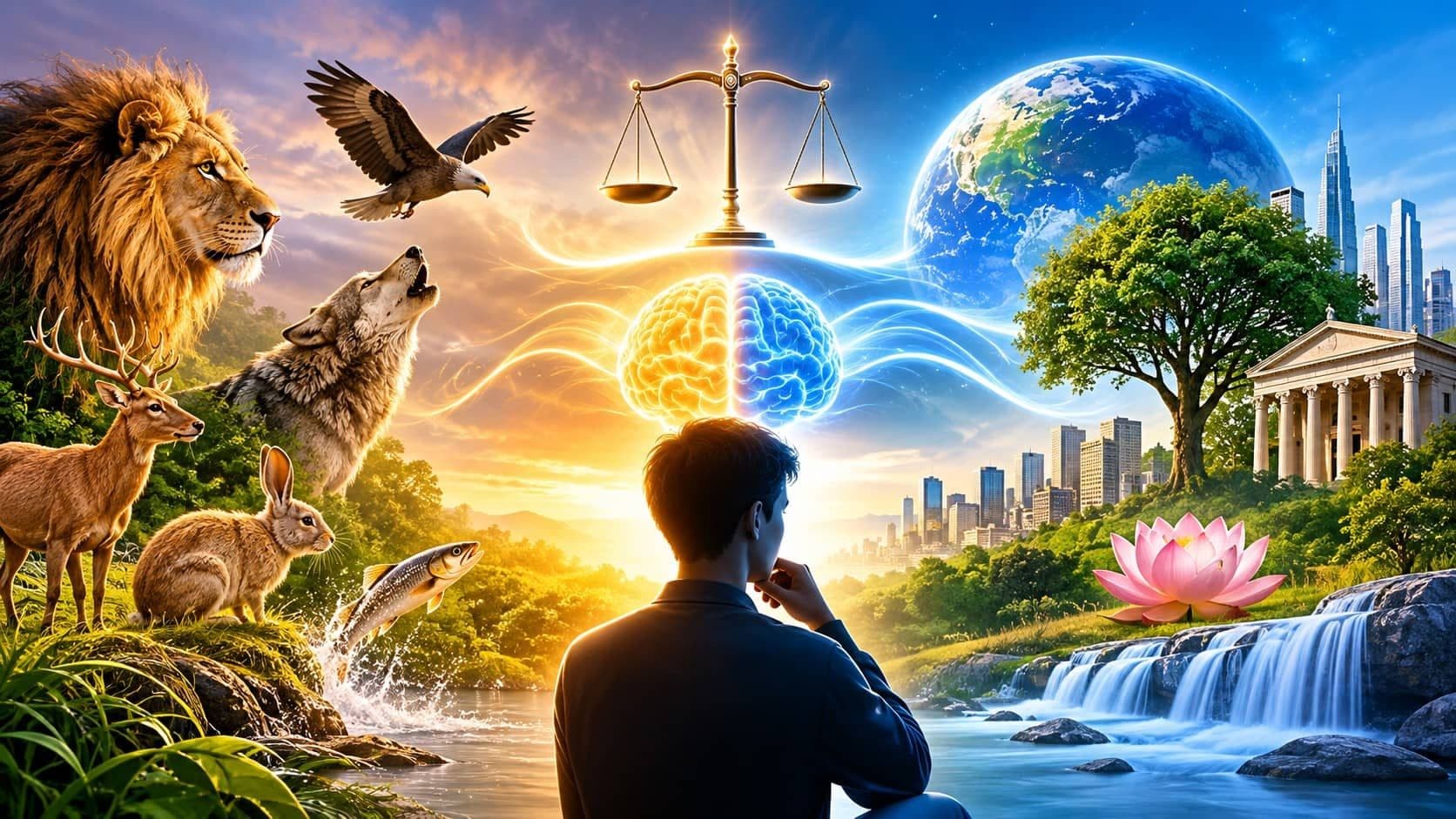
THE INSTINCT OFF ALL SPECIES ARE NATURALLY PROGRAMMED AUTOMATICALLY
The instinct of all species are naturally programmed automatically, but they are not entirely the same. Human beings aren’t controlled by instinct much, but animals live and survive by their instinct because they do not understand rationalisation. They eat, sleep and do everything according to their instinct, they do not think. Therefore, their instinct is better than human beings.
For example, a hungry dog will eat the food immediately when we feed him. If another dog come to eat the same portion, they will start fighting with each other. Even when the two dogs are playing happily, if we only give them one piece of a bone, they will fight over this one piece of bone. That is the natural instinct of animals.
However, as human beings, we should not and must not behave that way. Although we feel hungry, and there are a lot of food available, we still must consider if the food is enough for other people before starting, and evern consider if we need to eat less or stop in order to leave more food for others. We do so because we don't live on instinct, we think rationally. However, it is not easy, we must learn to how to control our thoughts in order to think rationally effectively. Therefore, there are many philosophers, scientists and masters, who had been honored as legends of all times because of their rationalisation.
Unlike human beings, animals are controlled by instinct, even they kill their own species. Some species kill themselves in a certain season during the year. It is because it has been naturally programmed in the their brain and they must follow. Human beings do not act like that. It's not easy for a human being to die as there are many challenges and difficulties before death.
So, there are two factors, which always control life of a human being. They are instinct and rationalisation (could be referred in this document as factual reasonion in some cases). Natural instinct urges us do what has been programmed in our brain, but what we are taught advise us not to live by our natural instinct. These two things sometimes can be the same... sometimes can be different.
So, would the love of parents for children be instinct or rationalisation? It is actually both instinct and rationalisation. Parents always love their children naturally, this is instinct. But parents also need to learn how to love and teach their children well so that they would become successful and good people for society. This part is controlled by our thinking/reasoning.
What about the love of children for parents? Is it instinct or reasoning? Deep down, our love for our parents is natural instinct. However, if we have to make effort trying to love them, that would require thinking, rationalisation. As for the love of parents for children, seven out of ten parts would be natural instinct, and the remaining three parts would be because of reasoning. On the contrary, as for the love of children for their parents, three parts would be natural instinct, and the remaining seven parts would be because of reasoning.
During childhood, a child would always call out for “Mum or Dad” when they encounter any problem. Parents are their refuge, their love and their protection from the time they were born. That refuge become instinct because they must depend on their parents. Through many years, that natural instinct turns into love. But when the child grows up and can solve problems on their own, they don’t need to rely on their parents anymore. And the love for their parents would become less and less. When they are a teenager, they can argue with their parents about everything to get what they want. Hence, the love of children for parents is not a strong instinct.
If there is not a good education system to teach children about their duties and obligations with their parents, they will easily forget this important duty. If we do forget our obligation with our parents, we will live no different to an animal life. A beast will forget its parents when it leaves the herd. Human beings have ethics, knowledge, and know how to reason with themselves, therefore we often force ourselves to love our parents in all circumstances. It is called filial piety. We must learn and practise hard to use it effectively. Whichever belongs to instinct, it would come naturally and we don't need to learn and train.
What about the love of a married couple? Is this instinct or reasoning? It is actually instinct, however, it requires ethic in order for it to be a successful and happy marriage. A man meets a woman and they love each other. Why? There are two reasons. One is due to the natural attraction between men and women. It is instinctively programmed for all species in the universe. The second reason is the karma factor. In this life, there are so many men and women, but we could have feeling and love only a very few. This is becuase of karma, the relationships between these men and women from their previous lives.
Thus, some elements of instinct are controlled by karma. Biologists or psychologisst would define that "instinct is a biological programming", but Buddhism defines that "instinct is the combination of both biological programming and past karma". Rationalisation does not depend on both biological programming and past karma. Rationalisation depend on moral and educational foundation.
The life of a human being always has both instinct and rationalisation. For example, a young man loved a young woman and wanted to marry her, but his parents did not approve of the marriage. They thought that because she came from a criminal family, and if he married this woman, the family reputation would be damaged. In addition, he was a lot older than this young woman, his education background was also much more higher than hers, they were afraid that the marriage would not be happy and successful at all. Their children, if any, would not grow up in a good environment.
In the scenario above, the parents only thought of the family reputation, what others would think of them, and the bloodline of their grandchildren... That was rationalisation. The love of the young man was instinct, which based on both biological programming and past karma. This young man was struggling to choose between the love of his life, and the disapproval of his parents for all of the right reasons.
All of us always face with these two factors in life: instinct and rationalisation. One part of instinct is past karma. According to Buddhism, karma is causality. It is always fair, and not many people can change it. In order to change it, we must practise Buddha's teachings, the Dharma, which would help change our past karma. Therefore, the more we study about our spiritual beliefs, and religious practice, it would not simply be only a struggle between instinct and rationalisation; it is actually the fight between living the existing karma and or changing to good karma to have a better life. It is really difficult to achieve this.
Written by:
Janna
Related Articles:
We Do Not Benefit From All of Our Blessings
How to Live Morally and Ethically – Virtue, Compassion and Blessings
Selflessness, Meditation, Wisdom, Compassion and Courage
Money, Power, Compassion, Wisdom, Success and Failure
Live Wisely with Compassion – The Balance of Wisdom and Kindness
Instruction on Meditation: Essential Methods and Practice Guide
The World Has Never Had a Standard Science of Meditation
Meditation Q&A 51–55: Impermanence, Body, Sin and Mindfulness