
When you treat someone, your words are the yang part,
and your thinking is the Yin. A good-hearted person speaks gentle, tender words - the Yin produce the Yang. And when you say gentle words, your minds naturally become a little more gentle.
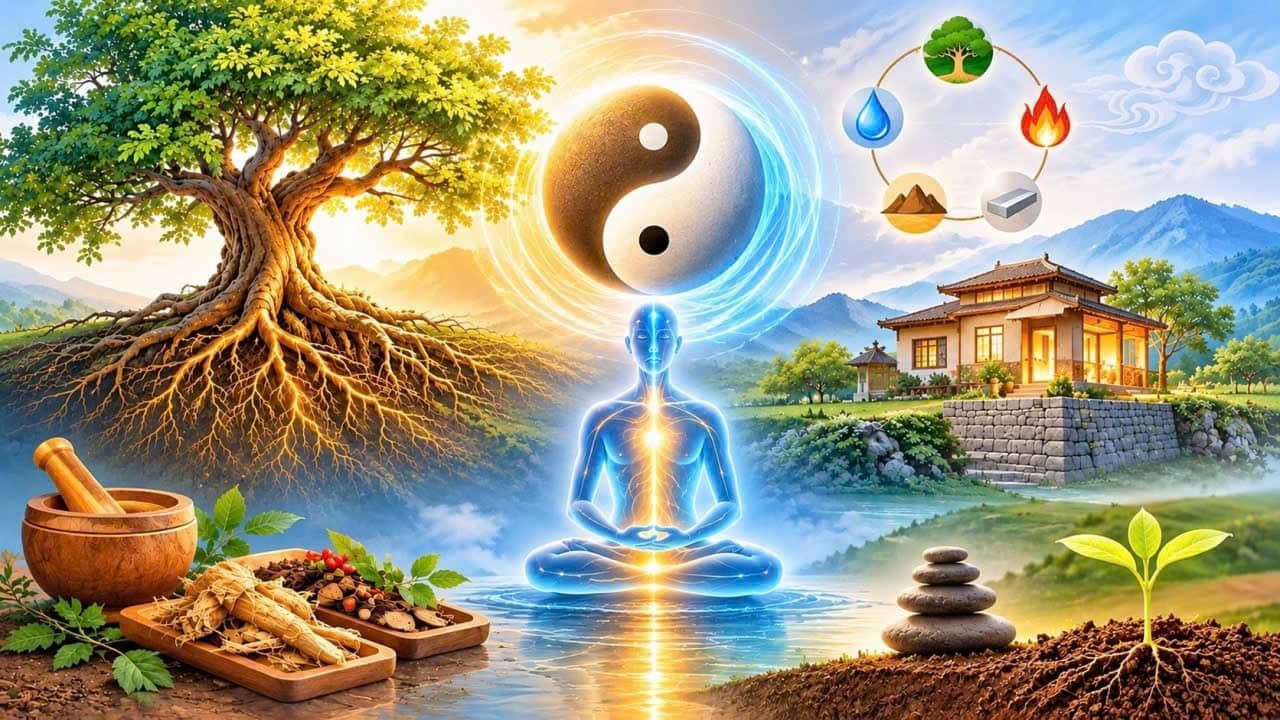
YANG SUPPORTS YIN
The second principle is that Yang can support Yin, but Yang is still of secondary importance.
We can understand this through the example of trees. As we have said, the root is Yin and responsible for bringing water and other nutrients to feed the tree. That is Yin produces Yang. The leaves also help absorb and convert energy from sunlight through the epidermis by photosynthesis and then feedback the roots, helping the roots to grow. Yin produces Yang, but Yang also supports Yin.
For an object, when either Yin or Yang dies, the object will collapse. However, Yin can exist without Yang for quite a long time. And without the Yin, the Yang will quickly disappear. Like a house, the foundation will still exist without the roof but not vice versa.
For humans, food is the yang part, and breathing is the Yin. Both are important to the body, but we can be still alive when fasting for seven days but will be dead if we breathe in for only five minutes.
One’s business is the Yang and his capital is Yin. Thanks to the capital - the yin part - he can do business, that is, the Yin produces the Yang. However, the Yang also supports the Yin. The profit of his business will help increase his capital.
When you treat someone, your words are the yang part, and your thinking is the Yin. A good-hearted person speaks gentle, tender words - the Yin produce the Yang. And when you say gentle words, your minds naturally become a little more gentle.
In the Sermon “One good turn deserves another,” we advised Buddhists, “You can use gentle words and harsh ones to ask, blame, criticize someone. Most people use harsh words for unfavorable conditions. It means you are aggressive, and you show your aggression. But from now on, you have to constrain yourselves. Even when you object to or criticize someone, you have to be gentle, and it will help you become gentle.”
Yin is the source of Yang, but Yang also supports Yin. You may not be good, but try to be gentle and kind to other people, and it’s your gentleness and kindness that help you become a good-hearted person. For Buddhist monks and nuns, maybe they haven’t been enlightened, but the Precepts force them to have saintlike manners when they walk, stand, or lie. Thanks to such dignify, their minds get improved. If the monk does whatever they want, their weaknesses will expose. Thus the Precepts have restrained the Yang part so that the Yin part will develop.
When we were novices, we were carefully taught appearance. One of the rules is not to swing the arms too far from the side when walking. It was so hard to do, but we had to obey it. We met another Master and asked:
-
Dear Master, it’s too hard not to swing the arms too far from the side, and it doesn’t look natural but like a robot.
-
You doesn’t look dignified if you swing your arms hard, but it’s not easy not to do so. You can hold something, a stick or a hat, for example, to avoid looking unnatural and fix your problem.
When my pagoda held a big ceremony, I was assigned to wire plugs and install loudspeakers. There was much work that needed to be done in a very short time. And I ran. I ran from the kitchen to the main shine and then to the worshipping house of the Patriarch. A senior monk called me and said, “no matter how urgent your work, don’t rush. A monk must remain his dignify.” I was confused at that time. If I didn’t rush, I couldn’t finish the work in time, but If I rushed, I would look ridiculous.” But after many years of practicing, when I recalled these words, I found them profound. Indeed, thanks to the outside, the inside gets improved. So we can say the Yin produces the Yang and the Yang supports the Yin.
You must have good thoughts to have good actions. And your good actions will improve your hearts. Without good actions, your hearts are unsure of being good. For example, a person always thoughts, “If I have money, I will give this man $1, that man $20, and help the boy selling lottery tickets by buying 3 tickets.” If he did nothing, then after a few days, his heart wouldn’t be good anymore. But if he gave a poor neighbor of his some food or gave needy people some clothes, then his heart will remain good. It’s how behavior supports the inner soul.
The Yin can exist by itself and produces the Yang, and the Yang depends on the Yin and also supports the Yin. This is the mutual relationship between the Yin and the Yang. Some don’t understand this principle and say that Yang produces the Yin, and it’s wrong. The Yin produces the Yang, and the Yang doesn’t produce the Yin but supports it.
The bigger the yin, the better yang develops
The second property between yin and yang is that the bigger the yin is, the better the yang will develop. If a thing has the yin part bigger than the yang, that thing is stable and durable.
If a house has the lower part (the foundation) larger than the upper part, then that house is very durable, but if the foundation is small, the upper part is large, and that house is fragile and in danger of collapse. If a person has the yin part stronger than the yang one, he is healthy. If a person has the yin weaker than the yang, he is frail and easily gets sick. Many people ask the question, “It’s yin or yang when a person dies?”
Many people are confused about this. They think that death is yin and life is yang. It’s untrue. As we have said that yin and yang are only in something that exists, and what is noticeable is yang and unnoticeable yin. Yin and Yang cannot exist in something that doesn’t exist. According to Oriental medicine, if blood vessels don’t work, the owner has been dead. So, please remember that Yin and Yang only exist in a living thing but not in a dead one, and Yin is the potential life, Yang is the revealed life.
In the human body, the revealed life includes flesh and blood vessels, etc., and they can be seen. And the potential life is the qi (the life force or flow of energy) circulating in the body called the meridian system. Western medicine does not focus on the yin and yang philosophy, so when the human body is infected, doctors only focus on healing the yang part, where the disease is seen, and they established medical principles based on viewable things. For example, they cure a headache by opening the brain to see if there is a disease. They cure a disease by giving medication to affect the artery, bone, flesh, and so on. As for coronary heart disease, surgery will be performed to re-open a blocked or narrowed artery around the heart. They treat where the problem is seen.
Oriental physicians cure a headache or dizziness or a heart attack by treating the kidney or liver because they think that this is where the root cause lies, and when the kidney or liver is fixed, the disease will go away. Asian people believe that in addition to the life of tendons and blood vessels (the visible/physical parts), the human body also has the life of spirituality, so they discovered the meridian system and cure diseases by acupuncture, impacting the qi circulating in the meridian system in the body. Oriental medicine can cure diseases by human electricity. The healer will put his hand on the patient and then transmit some of his electricity to the patient to increase his life force, making him less sick.
Oriental medicine is focused on the meridian system of the body. An oriental physician once told us that Oriental medicine is very different from the Western one. Western medicine cares about how it affects blood, intestines, i.e., visible things, and Oriental medicine cares about how it affects the meridian system - invisible things. Oriental medicine can cure many diseases. This is a unique point of Oriental medicine.
Yin and Yang go against each other
Yin and Yang are often said to go against each other. What are these cases?
For example, the roots and leaves of a tree. If without the trunk, they cannot live because one needs soil and water, and the other needs light. What will happen with water and fire if without anything between, a pot, for example? The water will extinguish the fire. But if there’s a pot, we will have boiling water.
That Yin and Yang go against each other means if Yin and Yang are in direct contact, they will go against each other.
Yin and Yang attract each other
Yin and Yang also have attractiveness for each other. For example, men like women, women like men.
In a family, the father usually loves daughters, and the mother loves sons. This is a very normal mentality.
However, practitioners who have attained a pure mind find no difference between Yin and Yang and are unaffected by the attraction between men and women. When the mind is pure, naturally, we no longer distinguish between men and women, and thus we less favor ones of the opposite sex.
Yin in Yang and Yang in Yin
For the human body, the head is Yang, and the legs are Yin. When the head is hot, it is lacking yin, which means there is no Yin in Yang, so the metabolism will start to be wrong. Because in principle, Yin and Yang must be in harmony, mutually support each other, Yin produces Yang and Yang supports Yin. If Yin and Yang separate, it is a recession. Therefore, the head is Yang, and if it gets hot, it is detached from Yin, which means that the person is ill.
And the legs are Yin, and if they get cold, they are too Yin, that is to say, Yang is separating from Yang, this person is also sick. So, in Eastern medicine, people with cool heads and hot feet are healthy. That is, Yin and Yang support each other.
The structure of the universe is similar - Yang in Yin and Yin in Yang. And in the human body, the abdomen and chest are Yang, and the vessel that governs the Yang meridians is called the Conception vessel. The Conception vessel starts from CV1 acupuncture point (Meeting of Yin, between the anus and the genitals) and goes anteriorly to the pubic region and ascends through the midline of the torso and of the neck and to the mouth and ends at CV24 acupuncture point (below the lower lip). The Conception vessel then encircles the mouth and enters it and reaches GV28 acupuncture point (Gum Intersection), where it meets the Governor vessel.
The Governor starts from GV1 Acupuncture Point (midway between the tip of the coccyx bone and the anus) ascends along the spine to GV20 Acupuncture Point on the top of the head then to GV26 Acupuncture Point and finally ends at GV28 Acupuncture Point, where it meets the Conception vessel. Therefore, when the tongue touches the upper jaw, it forms a Governor-Conception circuit in the body. This is an important principle in qigong.
The Governor vessel (The Du vessel) governs all of the Yang Meridians in the body, and the Conception vessel governs the Yin ones. The front of the body is considered Yin, and the back Yang, so the Conception vessel is at the front and the Governor vessel is at the back of the body. These two vessels represent the circulation of nature. Practitioners of the religion seeking immortality consider this a sacred thing, and thus they have tried to open these two vessels with drastic methods.
In fact, these two vessels will be opened by the impact of yin power. When our minds are pure and serene, these two vessels will be opened.
In the middle of the soles are the Yang acupuncture points KD1 (Gushing Spring), that’s why we say Yang in Yin. And on the top of the head (Yang) is the Yin acupuncture point called GV20 Acupuncture Point (Hundred Convergences), that’s why we say Yin in Yang. Many people still argue that GV20 acupuncture point is not necessarily Yin or Yang, but the truth it is more yin.
Relativity
Yin and Yang have one more property that is relativity.
A thing is Yin when it is compared to this thing but becomes Yang when it is compared to that thing.
For the human body, the skin is Yang when it is compared to the flesh, and both the skin and flesh are Yang when they are compared to the bone. And the skin, the flesh, and the bone are Yang when they are compared to the marrow.
Let’s start from the root
In the prevention and treatment of disease, making impact on the upper part of the body such as the head, face, chest is not as good as that on the back or on the sole of the foot because those two parts are yin. Thus, when a person has windstroke, we shouldn’t treat his face but his back. Pressing the soles of the feet also makes the body strong.
The soles of the feet are unnoticeable, hence they are yin and decide our health. Anyone who studies Oriental medicine knows that important human acupuncture points are on the back, and for that reason, whenever we get sick, we press on the acupuncture points there. It much helps.
Most of our diseases are caused by a lack of Yin. For example, now we have a swelling. Swelling is Yang because it is noticeable. But why does it appear? Because of a lack of Yin, that is, our bodies are getting hot somewhere. Ancient people had interesting words for food: hot and cool. And instead of putting antiseptic on the swelling, they took the medicine that cools the liver and kidneys, and the swelling would subside. There was no need to use antibiotics.
Focusing on the Yin, we are likely to win.
Most of the herbal medicines are roots; few are leaves. Roots are yin, and they will support the Yin part of our bodies. The ancients believed that when one got sick, he should find the root of the disease and cured it, and the body would recover itself. Therefore, most of the herbal medicines for healing are roots; leaves and fruits only complement the Yang. Good physicians pay attention to the root, not the top.
Geomancy applies this principle. It is believed that when ancestral graves are in a good place, the descendants will be successful. They reason that graves are Yin and the descendants are Yang, and when the Yin develops, the Yang will develop as a result. The ancients were so convinced of this that there was a proverb that said, “One’s ancestral graves decide his life.”
Phan Ke Binh wrote about Vietnam’s talents in his book Nam Hai Di Nhan, and he always included the places of their ancestral graves. The ancients believed in geomancy.
Today, many people much believe in geomancy and become superstitious. They use geomancy to explain everything in their lives. Some have Feng shui experts rearrange their houses, and they believe that it will help them have only good things. We’re not sure if they will be satisfied with their work but sure that they are taken advantage of. They both lose their money and annoy their neighbors.
Buddhist teachings do not deny geomancy because it is not outside the Law of Cause and Effect. The phenomena and things around us are a sign of retribution for what we have done. Fortune tellers or feng shui experts are those who can read that sign for future predictions.
According to the Law of Cause and Effect, the root of our success is our yin blessings, in other words, our past blessings - the blessings from our past lives. It is our past blessings that bring success for us this life, but not our talents, good looks, or persuasiveness.
For example, we make bean spout with green beans. After a few days, the green beans grow into stalks. These stalks are actually roots - the yin parts. Then each bean splits into two leaves - the yang part. Roots appear first, then leaves. It is a natural principle and a lesson for us: When we start something, let start with its yin part, the root, first, but not the top.
Likewise, when building a house, smart people always build a strong foundation first, and the house will be sustainable. When our politicians wanted to gain independence from the anti-French resistance war, they had to build a revolution force, starting with the intelligence force. The intelligence force included soldiers brave, independent, creative, clever, and worthy of being “ears and eyes” of the Party and State. A military strategist said: “Grasping your enemy and yourself, you will win.” To grasp the enemy, you must have a good intelligence force. Thanks to an ingenious intelligence force operating in all fields, such as politics, defense, security, foreign affairs, economics, science and technology, the cultural and social sphere, Vietnam has achieved independence and liberation for the country - incredible feats in the national history.
Organizations that cared about the number of soldiers, not intelligence forces, were all smashed by the French. It’s because they did not build the yin part, the intelligence force, first, but the yang part; hence they all failed.
Similarly, if we want to become a monk, let’s build the Yin - blessings - first. Don’t mind the appearance because it is Yang. Some hastily shaved their heads and wore robes while they had few blessings and little spiritual strength. The consequence was that their religious lives were unsustainable - they had to return to the secular world in the end. On the contrary, some wished to become monks, but they didn’t hastily make their wishes come true. First, they asked to do manual labor like cooking, gardening, and cleaning toilets to serve other people. After years of doing so, their blessings and merit increased, their spiritual abilities strengthened, and when they were allowed to be ordained, their religious lives were sustainable.
Remember the roots of a sprout grow first, then two tiny leaves. When you want to do anything, start with the root. Make the root strong enough, then build other things. This principle applies to everything in life. For example, if a thing has its yin part big comparing to the yang part, it will last for a long time, and if the opposite is true, it will pass away soon. Chili plants are quite big, but they cannot live more than two years due to their small fibrous roots. Ancient trees, with roots growing deep and wide underground, a bodhi tree is an example, its roots can reach as far as 50 meters or 100 meters, broader than its canopy of leaves, will seem to exist forever.
For humans, the greater their yin parts are, the easier their careers succeed. According to our forefathers, the ratio of the yin to the yang should be 5:1. For example, if you have 6000$, when asked, you should say that you have only 1000$. You should never show out all your strengths, just a part of them, if necessary. In this way, your strengths will be sustainable.
Many parents left much property to their children; these children are sure to have unsuccessful careers and all their property will be sold out. It’s because property is yang. If parents strengthen their children’s morality and leave them some secret capital and a wealth of experience, it’s very easy for their children to succeed.
Similarly, if someone tells us how wealthy he is or how many powerful people he has relationships with, he is exposing too much yang, which results in instability. Such a person often lies and has a short life and an unstable career. We shouldn’t have a close relationship with him. We should make friends with those who rarely talk about themselves. We can only understand such people when we spend a long time with them. These people are stable and profound. They will never betray us because their yin parts are much bigger than yang ones. They have considerable talents and virtues and never show them off.
When you’re going to build a 3-story house, if you build the foundation for a 3-story house then that house is unstable. Because when you want to turn that house into a 5-story one, you have to build another foundation. However, if you build the foundation for the 10-story house in the beginning, and later when you want to turn it into the 5-story one, you don’t need to break anything.
Please remember that if an object has the yang too large, larger than the yin, that object will not last long. Therefore, we always develop our yin parts by far more than the yang, and our happy life can last long.
Written by:
Janna
Related Articles:
Yin Is the Source of Yang: The Importance of the Hidden Part
Let Your Soul Be Filled with Morals
The Teachings from Ordinary Things – Finding Dharma in Daily Life
What Do You See? – Discovering the Dharma in Everyday Life
Quiet but Eloquent: Sincerity, Wisdom and the Balance of Mind
Instruction on Meditation: Essential Methods and Practice Guide
The Basic Meditation Technique: 5 Essential Steps to Practice Meditation
Meditation, Business Intuition and Wisdom Without Greed
Meditation Q&A 101–105: Seven Factors of Enlightenment and Six Supernatural Powers