
Janna · Jul 22, 2026
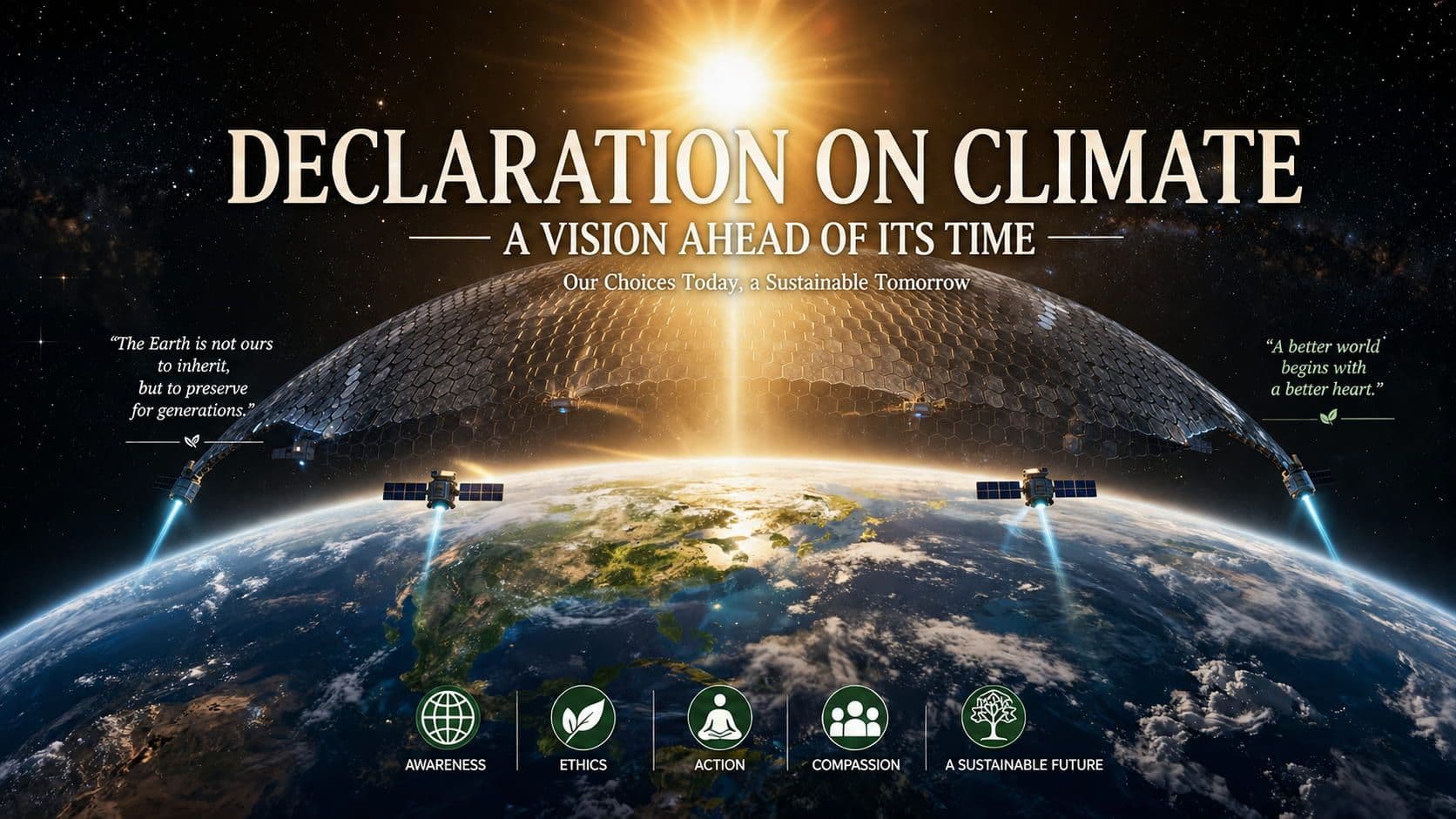
DECLARATION ON CLIMATE – A VISION AHEAD OF ITS TIME
Some people see only what is happening before their eyes. Some can see a few years into the future. But there are also those who, through profound wisdom and broad vision, recognize humanity’s challenges long before the world realizes their seriousness.
Many years ago, the global climate crisis was discussed not only from the perspective of environmental science but also through the lenses of morality, karma, and human responsibility toward the Earth.
While the world continues to debate the causes and solutions, there exists a deeper root cause: the distortion of humanity’s purpose in life.
The following article may be regarded as a declaration on climate—a statement that not only warns of the dangers of global warming but also points toward a fundamental path to preserving life on this planet.
WHY IS THE EARTH BECOMING INCREASINGLY HOTTER, THREATENING THE SURVIVAL OF ALL SPECIES, AS IF THE DAY OF DOOM WERE APPROACHING?
The immediate cause has long been explained by scientists: human beings burn excessive amounts of fossil fuels, releasing large quantities of carbon dioxide into the atmosphere. Carbon dioxide has the property of trapping heat from sunlight and preventing it from escaping into outer space. As a result, global temperatures continue to rise and are now approaching the tolerance limits of many living species. In other words, a global catastrophe is drawing nearer, even faster than many predictions anticipated.
Why do humans use so much fossil fuel?
Fuel produces energy, and human beings use energy to carry out countless activities. The physical strength of the human body is limited and insufficient for large-scale work. However, human intelligence has enabled people to extract fuel from nature and convert it into energy. This energy powers vehicles, airplanes, industrial machinery, electricity, lighting, air-conditioning systems, sound systems, spacecraft, computers, and even weapons capable of mass destruction.
In general, humanity has borrowed—or appropriated—natural resources and transformed them into energy for its own use.
If human beings are intelligent enough to utilize natural resources to improve their lives, what is wrong with that? Why should they pay the price of enduring extreme heat waves that are approaching levels capable of destroying life itself?
At first glance, there may seem to be nothing objectionable about exploiting natural resources for human needs. However, upon closer examination, we may find that more than half of those resources are used for purposes that are wasteful, unnecessary, morally unproductive, or even destructive. Some are used to harm and kill other human beings.
If we were to conduct a careful analysis, we might discover that a large portion of natural resources is consumed for frivolous, harmful, wasteful, cruel, or unethical purposes.
Before becoming angry at this statement, take the time to examine it calmly. One may then realize how many mistakes humanity has made. Even when our actions are not outright sinful, they are often wasteful.
The misuse of natural resources inevitably leads to consequences, including catastrophic heat that could threaten life on Earth.
When humanity adopts a powerful and determined purpose—to perfect itself morally, to become extraordinarily virtuous and deeply saintly—two results will emerge.
First, the consumption of fossil fuels will decline rapidly.
Second, the Sun itself will naturally adjust its radiance so that Earth’s climate and weather remain favorable. Human morality, according to this view, possesses the power to influence even the intensity of sunlight.
Therefore, anyone who wishes to protect life on Earth should encourage humanity to live ethically, have deep faith in the law of cause and effect, love one another, and support one another in the practice of meditation directed toward enlightenment.
According to this perspective, that is the only path capable of saving the Earth.
Conclusion
In summary, we may come to recognize that the climate issue is not merely a matter of carbon emissions, fossil fuels, or green technology. It is also a matter of human morality.
The future of the Earth depends not only on scientific and technological solutions but also on the ethical choices humanity makes and the values by which people choose to live.
Janna